
Symphonium Zenith IEM Review - The NightFury
From the makers of Giant and Titan, Symphonium has epic experience under its belt—and a cult following to prove it. Their newest, a collab with Elise Audio, finalizes the four-BA lineage with a banger of a finale. It’s their best yet. In the under-$2k category of top-end IEMs, Zenith has no adversary—it’s the king. Feed it desktop power and jaw meet floor.

Pros
- Unbelievable sonics
- Small and light shells are bomb proof
- Gorgeous unique faceplates
- Ridiculously good bass for a BA
- Fast, punchy and dynamic sound
- Very musical
- Excellent extension
- Vented and tubeless design
- Great stock cable, with option for upgrade
- Tons of amazing tech innovations
- Scales like mad
- For this level of performance the price is amazing
Cons
- Sonically nothing
- Ultra-low impedance wants a lot of power
Welcome, dear friends and lovely audiophiles the world over, to my newest review—the Symphonium Audio Zenith! This is a crazy good IEM, full stop. As a reviewer focused primarily on summit-level gear, I’ve watched prices reach epidemic scale, with no end in sight. Zenith is a breath of fresh air in this dark and expensive world. Coming in at $1799, while not cheap, it packs a wallop worth double or more. I think it’s the best IEM you can find under $2k, and that’s a crowded market with a ton of great stuff. I’d argue it’s one of the best ever made, regardless of price—and that’s a serious statement I don’t take lightly.
Some will immediately point to the similarities with Mr. Summit of summit IEMs, Subtonic STORM. And for good reason: the good folks at Symphonium are the ones who physically build STORM. They also helped with the tuning and design, part of the Nihilo family of companies rocking it out of Singapore for our common benefit. The shape is similar, but smaller and less intense in the ear. It needs power like STORM, but more on that later. There are similarities in sound too, though that statement is far too broad and doesn’t do Zenith justice. If you’ve ever had a Symphonium IEM in your ears, Zenith will feel right at home. The shape and finish are excellent—but this time tubeless and vented. Huzzah!
But that’s not all. Zenith brought in the tuning talents of Ahmed of Elise Audio—a man known for his unbridled passion for IEMs, and for tinkering with them. Endlessly chasing perfection, he’s a nonstop machine of tweaks and improvements. This partnership brings us the most mature, versatile, boundless and soulful IEM Symphonium has made—and an absolute steal for the price.
I love it, it’s in my ears on a daily basis. I even did a full month tour with only Zenith, and it was a blast.


DISCLAIMER AND TESTING DETAILS
-I received Zenith directly from Symphonium as a long-term loan. It remains the property of Symphonium and will be returned when I’m done. I was never asked for anything beyond my honest feedback and impressions.
-I review because I love doing so. No one pays me for reviews, ever. Some gear I get to keep, but it’s never conditional on a positive review. If I recommend something, it’s because I genuinely loved it and think you might too.
-I’m a small boutique shop. These reviews take a huge amount of time, so I focus on gear that genuinely interests me — things I’d personally want to own. Please keep that in mind.
-I start with a varied playlist of testing tracks to form initial impressions, then spend several weeks listening naturally to whatever inspires me. Before writing, I return to those testing tracks once more. I also listen to the gear while writing the review itself.
-To form an honest opinion, I think it’s necessary to test with lots of different music. If you’re taking a reviewer’s word about a piece of gear, in my opinion, you must take into consideration how their musical tastes match or differ from your own.
IEMs used for testing: Subtonic STORM, Mysticraft HEX, Dita Ventura, CFA Clara, 64A 18t.
DAPs used: iBasso 340MAX Ti, LP6 Ti 7th AE, Lotoo GT2, Nipo A100ME
Desktop rig: Matrix NT-1, Mola Mola Tambaqui, Zähl H1 or SAEQ Astraeus amplifiers, all fed with Arctand cables.
PACKAGING
I received the Zenith without any packaging or accessories, just a demo unit with the stock cable in a cloth bag. I therefore cannot comment on the packaging or included accessories.
Build
These are built like a tank, with solid anodized AL6063 aluminum shells. Their color depends on the angle you view them from—sometimes dark green, dark blue, even black, like an iridescent SL500 Benz you catch flying by on the highway. It’s a great effect, without coming off as cheap or overly gaudy. The micro-texture is subtle but noticeable, giving them a touch of class and no annoying fingerprints to speak of. The size is just right; they feel solid but light. That legendary Symphonium shape, only more streamlined and perfected from years of work and owner-driven feedback.
The faceplates are forged carbon composite, which means every Zenith has a unique look. Purple and green, teal, black and silver swirl and sway in a beautiful wood-grain kind of way. They even feel a bit like bare wood; slide your finger across the faceplate and it feels organic and real. Overall, the look is awesome.
Their updated nozzle from Europe makes a return here, offering a very comfortable fit. I get a super solid seal, and I can wear them for hours. The vented and tubeless design not only makes for a wildly enjoyable sonic presentation, it’s also pressure-free. I always felt great security with Symphonium’s 2-pin sockets. While not recessed, they are nice and snug without any play or wiggle, and never so tight you feel you could snap off a pin during a mad cable rolling session.
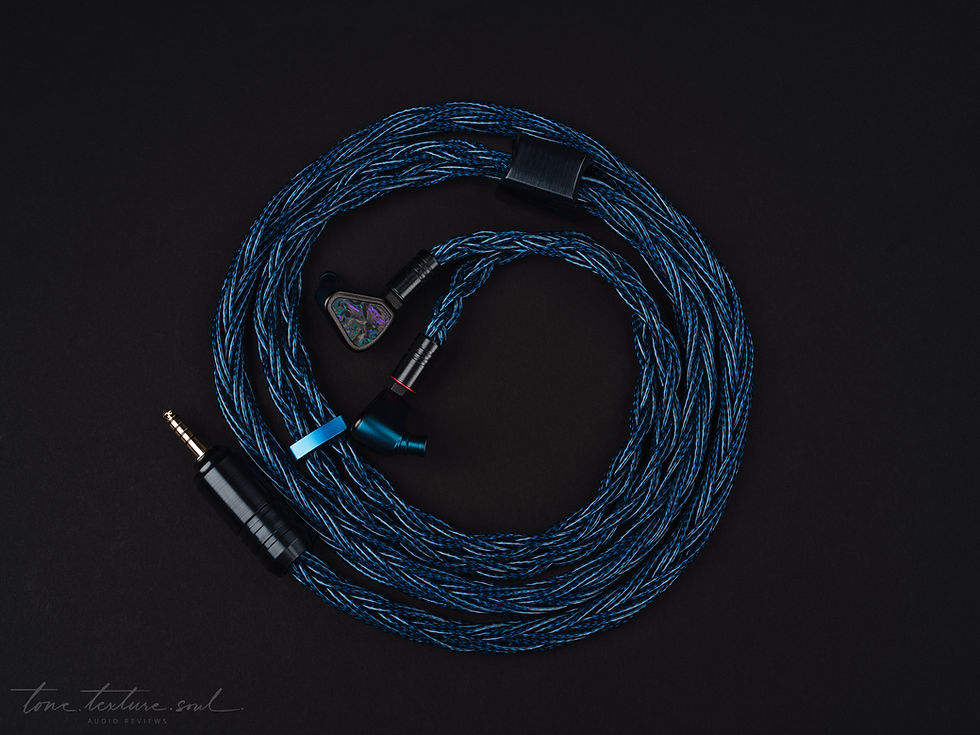
The stock Litmus cable from Altalune Audio has great synergy with Zenith. It’s a two-wire twisted pair, all in black, and matches nicely—though I’m not super keen on its rubbery feel. There are no ear hooks, which is nice, but it’s still a little wiggly until you get it settled. Sonically, it’s a great match, and I was able to enjoy Zenith fully on stock. Keeping with Zenith’s ultra low impedance design, the cable - and connectors- also feature this tech. The package includes modular 3.5mm and 4.4mm plugs. I only have the 4.4mm here, but that’s what I prefer anyway.
Ultimately, I ended up with aftermarket cables, as I always do. I have plenty around from prior reviews, and part of the fun of IEMs is swapping to your heart’s content. Zenith really scales—not only with power, but with cables too. It’s insane with the Nightjar Sovereign Symphony 4W, though it costs three times more, which gets a bit silly.
You can also opt for a factory upgrade option with the Vortex Cables Iris 8W, which unfortunately I don’t have to try. I do have a super cool Vortex prototype here, and it’s awesome with Zenith. It suffers that same rubbery fate though, as much as I might like it sonically, that feel never stays on my IEMs very long.


SYMPHONIUM INTRO
I’ve hung out with the guys from Symphonium on several occasions now, and a more talented, dedicated and hilarious team there is not. These guys live and breathe audio. Their fascination with perfection—and having a great time chasing it—has made them legends in the community. We talk shop endlessly, but there’s no shortage of laughs along the way.
Zenith led them on quite a journey. As their first vented design, it required a ton of research and many, many prototypes. Each aspect was insanely investigated, they even used different wiring for each driver for maximum signal flow! They designed the internal chambers exhaustively to reduce resonance issues. Like a studio that needs exact speaker placement, dampening and panels to achieve glorious balance, free from yucky reflections and garbled placement. This process is just fascinating for me. I used to build guitar pedal boards and we also used different wire, even in alternating polarity directions, to achieve that magic balance.
At its core, Zenith is “just” a four-BA IEM, though even that is too generous a paraphrase. Calling Zenith simple is ridiculous—the opposite is true, and the results are anything but. A four-way crossover and tech like CORE and FLAT (coming from STORM) allow Zenith to perform its best from any source, power-dependent of course. As I mentioned earlier, like STORM, Zenith really loves power. You can run it from a dongle and it sounds great; the true magic comes when you turn up the heat. Running it from 340MAX is something special. I’m only a few volume notches below where I use STORM. Same goes for GT2, or Evo Aria Cu. I like to listen on the louder side, with great dynamics, and this little guy packs a serious punch when given the opportunity. When I use my desktop system, Zenith transmogrifies into a flame thrower from another world. It’s hard to come back once you’ve heard it.
How a $1799 IEM can sound like this—so huge and detailed—is just endgame.


Let’s check out what Symphonium lists on their website specs (edited for brevity):
Since the debut of our very first four-driver IEM, Helios, we have continuously pioneered, iterated and refined the art of four drivers. We have chased every acoustic nuance to its absolute limit, refining the four-driver architecture until every variable has been mastered.
That five-year-long journey ends here. This is Zenith.
TrueX™ 4-Way Crossover
CORE+™ and PHAT™ Technology
FLAT™ Impedance Technology
Custom Tuned Balanced Armature Design
Forged Carbon Composite Faceplates
Anodized AL6063 Aluminium Shell
Azla Sednafit Origins and Divinus Velvet Wide Eartips
24AWG Litmus in 2 Wire Twisted Configuration
Interchangeable Plugs w/3.5mm and 4.4mm Heads
Hand-Crafted in Singapore
Cable:
Altalune Audio Litmus 2W
Zenith is the result of an exhaustive process spanning over fifteen unique prototypes, each one critically evaluated and refined. Throughout this development, we worked in close, continuous dialogue with Elise Audio. For over a year, every iteration was debated, adjusted, and re-evaluated until both teams agreed the tuning had achieved its intended balance of precision and musicality; representing the peak of its next-gen platform.
Resolution Without Compromise
At Zenith's heart lies an acoustic labyrinth, a chamber of mathematically modeled shapes made possible only by precision 3D printing. This process allows us to craft complex, organic structures that act as a sonic filter, eradicating unwanted resonances that traditional tube architectures grapple with. Crucially, this architecture is integrated with a pressure-relief vent for fatigue-free listening.
Refined Pressure Relief
Venting IEMs have always been challenging for manufacturers particularly due to the risk of dirt and dust accumulation from suboptimal venting hole placement. We addressed this issue with a two-step venting system - Our chambering system first relieves pressure by venting into the internal cavity of the shell. The internal cavity then vents itself out via our uniquely placed under-socket secondary vent. This unique approach minimizes potential dirt and dust build-up over time while ensuring the delicate inner vent is not damaged from daily use.
All Things Internal
An IEM's internal wiring is its circulatory system, the unseen network that delivers punch, dynamics, and flow. In Zenith, wiring is not uniform. Each driver receives a dedicated wiring configuration, with varying gauge and material to optimize every driver’s sonic character and deliver every transient with authority.
Driver Crossover
TrueX™ Custom Crossover with CORE+™
Frequency Response
10Hz - 20kHz, ± 2 dB
Sensitivity
108dB/Vrms @ 1 kHz
Impedance
6.10 Ohms @ 1 kHz
Socket
Spring Loaded 0.78mm 2-Pin
Cable
Litmus 24AWG Pure OCC Copper Litz Twisted Pair
4.4mm - ~0.187 Ω
3.5mm - ~0.188 Ω
Interchangeable Termination w/4.4mm and 3.5mm plugs
Iris 22.1AWG Taiwan 7N Silver Plated OCC Litz Type 7 Helix
4.4mm - ~0.0932 Ω
Cable Impedance
0.18 Ohms (3.5mm), 0.18 Ohms (4.4mm) @ 1kHz (4-Wire)
Warranty
1-Year Limited
There’s tons of goodies in the Zenith design. Most notably is the ultra-low impedance, including the cable and connectors. This is what makes the Zenith harder to drive than almost every other IEM out there. Even to get the volume where I want it, not just synergy, requires a great deal of juice. The more you give it, the more it shines. Symphonium says it best:
“You don't have to own a desktop rig to enjoy it. But if you do, Zenith will be ready.”
Boom.


SOUND
Zenith is an amazing listen, with a detailed and beautifully balanced sound. Powerful bass, textured and rumbly despite its BA architecture. Clear, clean mids with just the right amount of warmth and weight. Extended treble that never gets fatiguing or edgy, partially due to a gentle roll-off in the extreme highs. It is fast and incisive, but never sharp. The more power you give it, the more graceful and effortless it becomes. These aren’t reference monitors the way STORM is, but I do find them faithful and natural. They don’t have STORM’s weighted mids or screaming tech—but for those who find STORM a touch too neutral or flat, I dare you not to love Zenith.
BASS
Ridiculously textured and seriously punchy. Fast decay. Given they’re BA drivers, the speed is crazy, never missing a beat. The biggest surprise is how deep they reach; I was startled the first time I heard them. A guttural rumble, delivered effortlessly. Obviously, you don’t get the moving-air feel only a dynamic driver can bring, but this is a very close second. I’d say it’s as good as STORM bass in texture, though less surround-sound and slightly more centered.
In quantity, Zenith is more neutral than STORM. I even swapped tips and cables around to maximize it. It’s not bass-light, but far more linear and reserved, favoring speed, accuracy and lightning-fast decay. I am wildly impressed with the texture. On tracks with modern bass from Ghost-Note, Meshell Ndegeocello or Victor Wooten, I get a realistic, punchy and accurate low end. It leaves nothing wanting. Something like Om Unit or D’Angelo’s Brown Sugar might feel a touch shy, but faithful and enjoyable. Tool has plenty of growl and snap, something not easy to do with a BA. With electronic music, some may prefer a bigger, bassier vibe, but that can be adjusted somewhat with cables or tips. This is not a bass cannon by any stretch; the killer stroke is its texture and pace.
Using my Ultra Bass testing track, full of sweeps and crazy sounds you’d never want to actually listen to, I hear a super-clean sweep from 120Hz down to 20Hz without fluctuation or dips of any kind. This is amazing. Even the best bass cannons out there could give more oomph, or be more gutturally satisfying, but likely less linear in presentation and stepless extension. Even HEX has some sway in volume as the lowest regions come into play.
Decay is quick, but in this case that’s a good thing, keeping it all cohesive, taut and deliciously punchy.
Very impressive.
MIDS
Clear, articulate and highly detailed. Superbly 3D, with excellent positioning and layering. Depth is particularly good. Zenith manages plenty of space between notes and fine microdetail, which is sublime given the modest two BAs doing the heavy lifting. I could use more weight and forwardness in the mids, but that’s purely subjective. I was able to partially solve the note weight with an SS4 or NC Selene cable, and add forwardness with AET07 tips. I wouldn’t go so far as to call Zenith lean, but it errs on the side of quick and articulate over warm and fuzzy. Or big and weighted.
I hear very clean transients that don’t offend, but remain highly technical. Upper mids are lively but not pronounced. A small dip at 5Khz avoids sizzle or extra sharpness. It’s tastefully done and very natural.
I hear convincing timbre and texture for all instruments, acoustic or electric. This is not often the case, a set will shine with acoustic instruments like guitars and pianos only to fail with electronic or simulated tones. Zenith I hear them as convincing, natural and realistic. There aren’t any overly accentuated regions that push things out of comfort or realism, and music sounds live and dynamic while never getting rich or syrupy. Super emotive they are not, but not cold or neutral either. If I wanted golden mids I’d take the Erlkonig or Traillii, for neutral I’d go with Storm, Zenith is nicely placed in the middle.
Voices are incredible, as would be expected from Symphonium. Full bodied, but never chesty or overly weighted. Crisp accents but never sibilant. Expressive and dynamic but never too colored. Male or female I am whisked off to heaven. A good test of mids for me is a drum kit - a solid snare whack tells me a lot about a set’s character. It should never sound recessed, or scooped out, but not bloated or cardboardy either. Add in some guitars, vocals, some shimmer up top, what have you, now pay close attention to the drums; does their attack and character remain clear with all that other stuff floating around, vying for your attention? With thundering bass do we still get that physicality and dynamics?
With Zenith you do, and that’s amazingly impressive.
TREBLE
Zenith has a spectacular top end. It’s revealing, clear and articulate, without ever breaking into harsh, spicy or sharp. Excellent extension, a wonderful sense of air and space, and detail for days. There is a gentle roll-off in the upper extremes, yet it translates to seemingly endless air; nothing feels missing. Microdetails and whispers float above you. Symphonium has a grand slam here, balancing resolution, transient speed and musicality. I never feel tired or overly stimulated, as can happen with extra-spicy sets, yet no information feels missing, masked or smoothed over.
My air test track, “Feel” from Jacob Collier, has an opening of kick drum and wavy sparkles in the highest registers. Then soft angelic voices come in near whispers. I love this track because it can change dramatically depending on the IEM. On some spicy sets like Rhapsodio Supreme V4, you can hear much more information up there - crisp outlines and clicks that sway to and fro above your head. The issue is, these sets can be overly bright with most other things, so it’s more of a party trick for testing rather than a tuning plus. Zenith manages 95% of this when it comes to presentation, but never becomes zingy or bright at all.
Another death track, Deftones’ “Digital Bath” is brick-wall mastered, so cymbals can zing and crackle with piercing attack on the wrong set. Zenith keeps the energy, weight and physicality of the crash and ride, while never blasting my face off with screeching thrash.
How they were able to pull this off with just BAs is truly amazing.


SOURCES
Zenith is sensitive to source, but mostly in terms of power. I found it remarkably unaffected by differences in color, tuning and presentation across the sources I tried. I think that’s a great thing, and a testament to Symphonium’s FLAT tech—it really works!
Zenith sounds like Zenith.
But that doesn’t mean you can’t tweak the chain to your heart’s content.
iBasso 340MAX Ti [review]
A wonderful pairing. More than ample power, huge headroom and massive macro dynamics. The stage is enormous, with deep, rumbly bass, clean ’n’ clear mids, and a nicely open and sparkling top end. The MAX’s nearly neutral tuning does wonders here, delivering a highly expressive and technical presentation with enough musicality, soul and swagger to please anyone.
The only downside might be the 340MAX’s slightly plasticky bass timbre, which doesn’t do Zenith’s low-end setup any favors—though the presentation is certainly authoritative.
EvoAria Evo One Ti
Another fantastic pairing, and a fantastic DAP. Similar in many ways to 340MAX, but a touch more refined and even more neutral. Better bass texture, slightly more resolving. The mids are more recessed, which isn’t ideal for Zenith’s slightly leaner mids—at least for my tastes—but very well may be for everyone else.
There’s huge power on tap, while the tubes bring a sweeter, more airy top end. It could be too neutral and clean for some.
The stage is ridiculously wide.
EvoAria Evo One Cu
This is jamming.
All the technical ability and refinement of the Ti, but with hugely forward and weighted mids, a big dose of upper-bass kick and grunt, and a softer, rolled-off top end. It doesn’t lose information; it merely wafts in space above you like gold.
The stage is smaller in width, but the depth is amazing. While the copper Evo One isn’t a jack of all trades, it is the master of this one. Warm, full, and super nice with Zenith.
Lotoo GT2 [review]
Similar in many ways to 340MAX, but with warmer mids and a smaller, less dynamic presentation. The top end can be a touch more energetic, and there is a larger bass boost.
For someone who wants to give Zenith a strong reference baseline while injecting some note weight, bass authority and extended treble—without adding too much else—this could be it. The stage is smaller and more intimate than 340MAX, but it has its own special sauce.
Luxury & Precision LP6 Ti 7th AE
This is my desert-island DAP, and it’s glorious. The best mids of all time, a hugely bombastic and explosive presentation, and oodles of texture.
Unfortunately, while its power output is tremendous, its current delivery is not. If you want to crank Zenith, the LP6 starts to current-starve and clip a bit. At quiet to moderate volume levels it can be wonderful, but it’s not an ideal source for big-volume jamming.
Tonality is off the chain, though.


STAGING
Zenith has a wonderfully balanced stage, extending in all directions evenly. I hear depth, height, decay and width all behaving not only naturally, but beautifully. It’s not massive, but it’s truly balanced. Top end space and air, vocals sitting out in front of you, with decays, reverbs and space sitting outside of that. It’s not cavernous wide, so it retains a realistic shape and presentation. There is plenty of separation, space between layers and breathing room, but never exaggerated for the sake of it. Positioning is also high level, with clear distinct instruments placed in 3D space. Nothing is vying for increased attention, just a liquid presentation of music as a whole.
DESKTOP
This thing really scales. Give it more power and the staging expands a great deal. It does so evenly, becoming better and better while remaining natural and realistic. With my desktop rig, I get something more akin to small headphones—a true wrap-around feeling. Obviously not in sheer stage size, but in the way it breathes and flows around you.
Feeding Zenith from the speaker taps of my SAEQ Astraeus is something to behold. With the Zähl H1, we’re getting into STORM territory—lightning-fast and ultra-technical. It won’t reach the sheer size of STORM, but it equals or surpasses sets costing twice as much or more.
It could be said that Zenith needs power to shine, but even that feels limiting.
Zenith rewards enormous power, but it doesn’t require it to sing.
The more you give it, the more it blasts off—it scales like summit-fi gear. But give it enough to get the volume pumping, and you’ll forget about everything else and get lost in the tunes.
CABLES
The stock cable is great, and many will be more than happy with it. In case you’re a tinkerer, here are some of my favorites.
Nightjar Sovereign ($3500 2W, $5500 4W) [review]
The SS4 is obvious overkill, considering the price - but if you want the best, and have one lying around, this pairing is ideal. Bigger, better bass, more fleshed-out and textured mids, extreme staging and a more weighted and organic sound. More detail, more space, more everything. Moving in the direction of STORM, crazy good. If you like forward and amazing mids, SS4 is the King of Kings.
Its only negative is the sheer weight and size, though it’s the softest and most pliable big cable you’ll ever use. It’s not cheap either.
You can get the 2W Sovereign for $3500, which is thinner, lighter and more ergonomic, not to mention much cheaper, for the ultimate in portability. Sonically it’s the same tuning as the 4W, just everything is less so. While still double the Zenith’s asking price, if you were to max out an ultra portable setup, this would be it.
Nightjar BlueHour ($1500 USD 2W, $2500 4W, $5000 8W)
Another great pairing, BH is cleaner and more extended. With more focus on sub-bass and top-end extension, the mids retain their neutral and articulate vibe. If you want top-notch technicals without altering an IEM’s tuning, the BH lineup is it. Mids stay where they are, but gain immense technicals and far more immersion. Staging is huge, pushing width to its limits—even to the point of exaggeration—in the coolest way possible.
On some occasions BH cables can break into cooler territory, so they work best when you want clean and clear, without any warmth or color. Zenith is a technical beast with insane vertical dynamics on BH8W.
Blue hour cables are extremely soft and pliable, using a much smaller individual wire vs SS. For the same technicals you need to double the wire count. The 2W and 4W variants are half price to the SS lineup, but potentially as expensive as SS4 in the 8W. Using the smaller 4W might be more realistic, both in terms of price and ergonomics. The 2w model would be perfect for a balance of portability and sonics.
Sonically the entire BH lineup shares the same tuning, but I found the small wire counts to sound thinner. Not detrimental, just leaner. Some may prefer this, I have a way of needing maximum note weight, which some may not prefer.
You may notice I’ve photographed Zenith a few times with a massive monster cable. That’s the BlueHour 16W! Basically a meme made for fun—as gargantuan in tone as it is in size—and costing about $10K (!!).
This is obviously not a suggested pairing. It is, however, one of the craziest chains you’ll ever hear—and a lot of fun to shoot.
For your consideration! 😉
Nightcraft Vesper ($1500 8W Shielding) [REVIEW]
Another nice pairing, though I found the top end a bit too much over long sessions. Bass is extremely good, more punchy and fleshed out. Lower mids have nice weight and great authority. Upper mids thin out a bit and ultimately fail my snare drum test, treble can be extremely extended, but also a bit too forward. It’s not bright, or harsh, but for me it’s too much. Many will like this kind of lively and very articulate presentation, the choice is yours.
Staging can also be a little too focused on depth and height, which is plentiful, but feeling a touch narrow overall.
Nightcraft Selene 4W ($2600 4W, $4700 8W) [REVIEW]
I really enjoyed this one, and it was my go-to for a few weeks.
Staging is massive, one of the largest stages on a cable I’ve heard. Bass is big and fat, punchy and luscious. It adds some mid-bass and punch, giving Zenith more authority and weight. Awesome bass. Mids are more forward and weighted too, while remaining highly technical in a way pure silver is known for. Top end is remarkably precise, without being bright or harsh at all. Selene manages a very modern silver sound with a hint of copper vibes which strikes a great balance with Zenith.
Overall very nice, and I love the black paracord. I wish the bare silver wires were less rubbery and springy.

COMPARISONS and PAIRINGS
SYMPHONIUM IEMs
I’ve had the chance to try the entire Symphonium lineup at several audio shows. My time with them was limited, so I’ll do my best here. They’re all really good, but before Zenith, I never truly gelled with any of them. Some sit in a lower price bracket, so let’s take a look at the closest two.
CRIMSON ($1499)
A fabulously fun IEM. V-tuned, bombastic and energetic. Big bass, sparkling highs, and mids that sit back in the mix. As you’ve undoubtedly heard plenty by now, I’m a mids lover. As much as I can enjoy Crimson for pure fun, it’s not something I would own.
It’s brighter than Zenith, with more bass, but still carries that signature Symphonium sound. It isn’t vented, so I do get some pressure.
Love the RED!
HELIOS ($1099)
The OG—the IEM that put Symphonium on the map. A great reference set, and a masterclass at $1K. In some ways, this is the precursor to Zenith and Europa. I hear plenty of similarities, only not as refined, polished or perfected. It’s now discontinued, so this isn’t an entirely fair comparison, but Helios deserves to be included.
It’s nicely balanced, with excellent speed and texture. Plenty of detail, strong staging, and wonderful extension. I don’t hear the same level of impact and punch, as well as finesse. The shell shape isn’t as perfected and the refinement sits a level below, but given its age next to Zenith, that makes sense.
Helios was top marks.
Zenith is simply the next generation of what is possible.
STORM ($7800)
The most obvious comparison for me is STORM, even though they are quite different. Part of it is the shape, the tuning, the vibe—it all feels familiar after years with STORM superglued in my ears. Of course, it’s more than four times the price, so there’s that.
Zenith is leaner, less resolving and less vast. Bass is similar in quality but a bit less in quantity. Mids are leaner and less forward. Treble feels more pronounced, but that is mostly because of the leaner midrange, as STORM is brighter overall. STORM has more air up top thanks to its EST drivers, while Zenith’s BAs have more body but less effortless space.
Overall, Zenith is more relaxed and forgiving—though it’s certainly not a relaxed set. STORM owners might guffaw at the direct comparison, but it must be made. They aren’t the same, yet if you want a STORM-lite kind of thing, strap a Sovereign on Zenith and it starts heading that way. Since they both need big power, Zenith isn’t exactly a portable setup when maxed out, but it can be so with a thinner cable and a powerful small DAP or dongle. For STORM owners, perhaps taking Zenith in another direction makes more sense.
DITA Ventura ($4500) [Review]
One of my main loves, Ventura is a beast. A single DD that sounds like a modern hybrid, it’s amazing. Tonality-wise, they are very different, with Dita being warmer and more textured - thanks of course to the DD that handles bass, mids and treble. Keeping in mind that Ventura is three times the price, including it here means top marks for Zenith.
Zenith has similar extension thanks to its crossover and separate drivers, but you lose a touch of the cohesion that makes Ventura so special. Ventura edges are a bit smoother, and there’s a warmer velvety quality, though it is staggeringly detailed and technical. Bass texture and decay I give to Ventura, speed to Zenith. Mids aren’t really fair - a DD midrange is my favorite, there is something just incomparable for that texture and realism. If you like a fast midrange Zenith is no slouch. Ventura is more weighted, though neither are thick.
Top end is not so dissimilar, with both being top notch performers in the highs. Ventura manages to be extremely resolving and extended while remaining deeply musical. It’s perhaps untouchable here, and deservedly so. Zenith is more modern, a touch less revealing and more edgy, but only in comparison. You might even feel Zenith is more technical at first, simply because it places that technicality front and foremost. Ventura is more refined, and its technicals require a moment to take in fully.
Again, comparing an ultra-flagship single DD with masterclass tuning to a sub-$2K IEM with four BAs is, at heart, unfair.
But that’s exactly why Zenith is so impressive.
I could grab either of these for a day out, or a tour, and they’d both blow me away.


64Audio 18t ($3000)
My old classic, I include it because it’s another full BA set. Marketed as reference by 64A, the Zenith shreds it to pieces in all respects. The bass is far more textured and rumbly, more believable. It’s far more controlled and the quantity is more linear and neutral over 18t’s fatty bass.
Mids are more musical, and less metallic in the upper mids. Weight is similar, with 18t being more forward but less resolving. Resolution-wise, Zenith is a step ahead on all counts.
Treble is a big win too, just more refined, open and spacious without the slight metallic sheen. 18t has the Tia driver and is super airy, but I prefer the Zenith here by a yard. We’re talking a few years of tech behind in the 18t, but as far as an all BA set the Zenith is a clear winner.
64A Forte ($3500 discontinued)
This is old tech vs new tech, but they’re both 4BA models and the comparison can’t be helped. They’re both tubeless designs with crafted resonance chambers and painstaking design bordering on madness.
Forte excelled in spaciousness and a surreal stage, which, at the time of release, was totally mind-blowing. Bass was guttural and awesome if a touch uncontrolled and lacking the last bit of refinement. Mids were a bit lean, and it could easily be too bright up top. But for all that, it was insanely impressive. Vocals were crazy and floated in space like a speaker system. My first wow moment in this hobby.
Zenith is a milestone ahead, years later we see what can be done with 4 BAs. The tech has come a long way, and Zenith is the new kid on the block. Bass is slightly less textured, but more controlled. Mids aren’t thick or weighted, but not nearly as thin as Forte could be. I find the Zenith mids a mile ahead here, retaining amazing clarity without the scooped-out leanness. The top end is far apart, with Forte being world-class but quite bright, while Zenith is less spacious and airy, but far less intense and bright, and much more realistic. Zenith stages more intimately but more evenly. Where Forte wowed with its massively wide stage it could come off incoherent as a result. More wow, but less solidified in reality.
CFA Clara ($2000) [Review]
These are about the same price, with Clara being a touch more expensive aside from the Ti special edition. Clara has a dual DD for bass and then all BAs, so aside from the bass they are similarly equipped.
Clara bass has better texture. It’s not really fair, as Clara’s bass is really nice. Zenith digs deeper though, with greater speed as one would expect from BAs. Decay is super fast while Clara lingers and stays big longer. Clara has more quantity too.
Mid-wise Clara goes for Sony-esque relaxed and musical vibes, Zenith is clearer, more technical and resolving. If you’re looking to chill Clara is great, but in terms of abilities, the Zenith is on another level.
Treble is somewhat similar but Clara has a touch of pinna gain where I don’t hear that on Zenith. While Zenith is going for a more modern and technical style, and Clara is more relaxed, it has a touch of pinna edge which is noticeable. Performance-wise, they’re somewhat similar though I’d give the edge to Zenith.
I could take either of these out for the day and just melt into my tunes, but Zenith is a step up in technicalities and presentation. Based on my preferences I align more with the Zenith, but some people might dig the Clara vibe more.


CONCLUSION
I said it before, and I’ll say it again: Zenith is a mammoth undertaking. A four-BA IEM that competes with the best in the world is crazy. Tubeless, vented, comfortable—and let’s not forget beautiful—it’s a powerhouse. A nice stock cable, comfy metal shells, and a joy to listen to. Its only real downside is the need for big power, but even that is subjective. I know people who love it from a dongle, and it sounds great from many things. There’s never been a better time for high end DAPs, you can further tweak its presentation that way too. Give it the power plant and you’ll be blown away by what it can do. It scales like summit-gear does, and that’s pretty amazing.
Let’s not forget the price—$1799. For this, it’s unbelievable. It’s not “cheap” in the grand scale of IEMs, but for this level of performance and build quality, I can say with great enthusiasm that it’s the best value in the IEM world right now. It deserves your attention, and wins my Best in Show award for value, and pure awesomeness!
It just goes to show what can happen when great minds meet—in this case, Symphonium and Elise Audio. Each brings something meaningful to the table, and the result is staggeringly good.
If you’ve got $2k and want the best, this is it.
Hands down.
I wish to thank the team at Symphonium for the loaner, and I hope to enjoy this bad boy for a long time to come. I also wish to thank the guys at Elise Audio, for their tireless efforts in tuning, and endless generosity to the community as a whole. Zenith is the new gold standard for what is possible with four BAs, it’s the top dog—and I can imagine that crown staying for a long time.
Thanks for reading!
You can get yours directly from Symphonium HERE.
Or from Elise Audio in the UK HERE.


