iBasso DX340MAX Ti DAP Review - More is More
Updated: Sep 10
With the hotly anticipated new iteration of the MAX series, iBasso has delivered something more new than upgraded with the DX 340MAX Ti. Adopting a 1-bit DAC and desktop-like power, it’s a whole new thing—and not ashamed to shout it from the rooftops. It’s brimming with potential, in a world of summit DAPs, the 340MAX is unique and amazing.

Pros
- Huge power with desktop-like presentation
- Very detailed and expansive sound
- Great imaging
- Harmonic modes offer varied tonal options
- Denser and more weighted than previous MAX versions
- Using DC power you get 2250mW+2250mW@32Ω!!
- Bombastic and fairly energetic
- New screen is wonderful
- Pitch-black background
- Extremely low output impedance
- Wider chassis with less depth is much more comfortable in hand
- Beautiful titanium finish
- UI is much faster
- Full Android and pure audio Mango systems
- Anantar Infinity Player gives incredible tuning options for adventurous tinkerers (NOT officially supported)
Cons
- Sound isn’t perfectly timbrally cohesive across the spectrum
- Bass has a touch of “BA” plastic timbre
- Mids are smooth and crisp at the same time
- Big and heavy
- Exposed power/volume knob is prone to accidental touches
- Needs 250+ hours of break-in to reach potential
Greetings, dear friends and fellow audiophiles around the world. I bid you welcome to my review: the new iteration of the iBasso flagship series, the DX340 MAX Ti. As a past owner and lover of the 320MAX, my sky-high expectations would require serious new features to battle the 320, which in my mind is one of the best transportable DAPs of all time. Decidedly neutral, oodles of power, and a very distinctive and defined technical sound that always remained musical.
What does the 340MAX bring to the table? For one, it uses a 1-bit DAC this time around, departing from ROHM. It has more power, expandable to a massive 2250mW+2250mW@32Ω using the DC input with Super Gain enabled. A more expansive stage with near-endless headroom that holds bass tight and true like a desktop system would. A large and beautiful screen—gone are the huge bezels of yore. It’s thinner. UI speed is improved, though not perfected. Volume knobs are on the side this time, with physical analog and digital control. Outputs are on the top.
On first listen, expecting that iBasso house sound out of the box, the MAX was decidedly warm, with thunderous bass that surpassed the 320M’s more conservative quantity. Mids pulled a bit back, more weighted, with a slight smoothness to them. The whole spectrum is denser, thicker. The treble is where the iconic iBasso sound remains, a touch metallic and splashy out of the box. Stage is gargantuan, but wider than tall, feeling a bit flattened out. On close inspection, I hear subtle timbral variances: voices a bit smooth, lower treble accentuated, and bass sort of plasticky. Parts are nearly sharp; others feel smoothed over, losing texture.
But after 200 hours of letting those inner components settle, things changed.
A lot.
More open, more solid, less splash. After 350 hours, the warmth is mostly gone, remaining only in the mids, and that classic MAX sound rears its head again. The more I listen, the more I like it. Not a 320MAX MK2—something different.
What I hear most with the 340M is insane potential. It’s like a race car rearing to show its power. Blow your hair back. The reality is, I feel that potential hasn’t been fully realized. The 320M laid everything on the table; I knew what I was getting—and it was raw. With the 340M, there is some mystery, untapped power hidden just beneath the surface. I’m not saying it’s missing; I’m simply saying I hear more to come.
Granted, this is splitting hairs, but for a DAP vying for the top spot, it’s warranted.
Perhaps I’m too critical; I’ll accept that.
I believe this is mostly due to component choice. After spending time with the new EvoAria Evo 1 DAPs, it became clear that their defining characteristic was hand-selected components. The maturity, refinement and synergy were sublime. All they charge for this is a paltry $7K USD, which is absurd, even if somehow warranted. When I mention the 340M’s unrealized potential, this is what I mean: if you’re playing with the top dogs, every decision matters. The critiques in this review are directly informed by this, and in that way, comparing 340M to the best DAPs ever, makes the 340M is even more impressive. It's a tiny difference, but it's there.
The 340MAX may divide some iBasso fans; it’s not quite what we expected. Some may prefer the 320’s brazen neutrality. Some may not like the warmer vibe in the mids, especially with the rest of the spectrum being more neutral. Being honest, I had a period of near-hatred with the 320MAX before it settled, both physically and mentally. After living with it—and the 340MAX too—what iBasso gives us here is unique and pretty amazing. In a crowded market, its powers—realized or not—warrant serious consideration from the most demanding listener.


DISCLAIMER AND TESTING DETAILS
-I received the DX340 MAX directly from iBasso. It is mine to keep on the condition that I continue to use it for future reviews. I was never asked for anything beyond my honest feedback and impressions.
-I review because I love doing so. Some gear I get to keep, but it’s never conditional on a positive review. If I recommend something, it’s because I genuinely loved it and think you might too.
-I’m a small boutique shop. These reviews take a huge amount of time, so I focus on gear that genuinely interests me — things I’d personally want to own. Please keep that in mind.
-I start with a varied playlist of testing tracks to form initial impressions, then spend several weeks listening naturally to whatever inspires me. Before writing, I return to those testing tracks once more. I also listen to the gear while writing the review itself.
-To form an honest opinion, I think it’s necessary to test with lots of different music. If you’re taking a reviewer’s word about a piece of gear, in my opinion, you must take into consideration how their musical tastes match or differ from your own.
IEMs used for testing: Subtonic STORM, Mysticraft HEX & TET, Symphonium Zenith, Dita Ventura, CFA Clara.
My ever-evolving testing playlist HERE
iBASSO INTRO
Having no connection with iBasso when I purchased my 320MAX, I bought it second-hand. I had always thought these giant DAPs were sort of silly, and only bit the bullet as a way to power STORM on the go. It took time to get used to its sound, and that attenuator drove me mad for a day or two. After some mental adjustment, I considered it my gold-standard neutral DAP and used it for countless reviews. My introduction to Paul of iBasso came through a friend who recommended me for their Epitome IEM. After a few email exchanges, it became clear the upcoming 340MAX was a better fit for my interests. When the final release came out, I received my demo unit, and the story begins.
PACKAGING
The 340MAX (hereafter referred to as 340M) comes in a big black box with iBasso written on the side. As with the 320M, the DAP is nestled in a velvet cutout, looking cozy and protected. Lift the top tray and you expose the accessory boxes: DC charger, USB-C cable, SPDIF cable, female USB to 4.4mm cable, warranty cards and manual, plus extra screen protectors. I count two for the front, in addition to the factory-applied one, and five for the back (two with an angled cut out leaving the titanium logo exposed), which is generous. I haven’t applied anything to the back, but probably should.
Also included is the green leather case, a beautiful piece that fits like a glove. Thankfully, a magnetic flap covers the top and holds so well I forgot it was there. Coming from the 320M, which slid out of its brown case every day, this is a great upgrade. A venting grille on the back lets the DAP breathe, and the pattern is quite cool. Someday people will start making black cases again (please!), but for now the winter green is nice.
As with all packaging, after I take the goodies out, I place it in my gear closet, never to be seen again. I don’t think twice about packaging that isn’t somehow useful after the fact. That’s just me. This is very protective and functional packaging—nothing ostentatious or excessive, which I prefer.


DESIGN
VOLUME
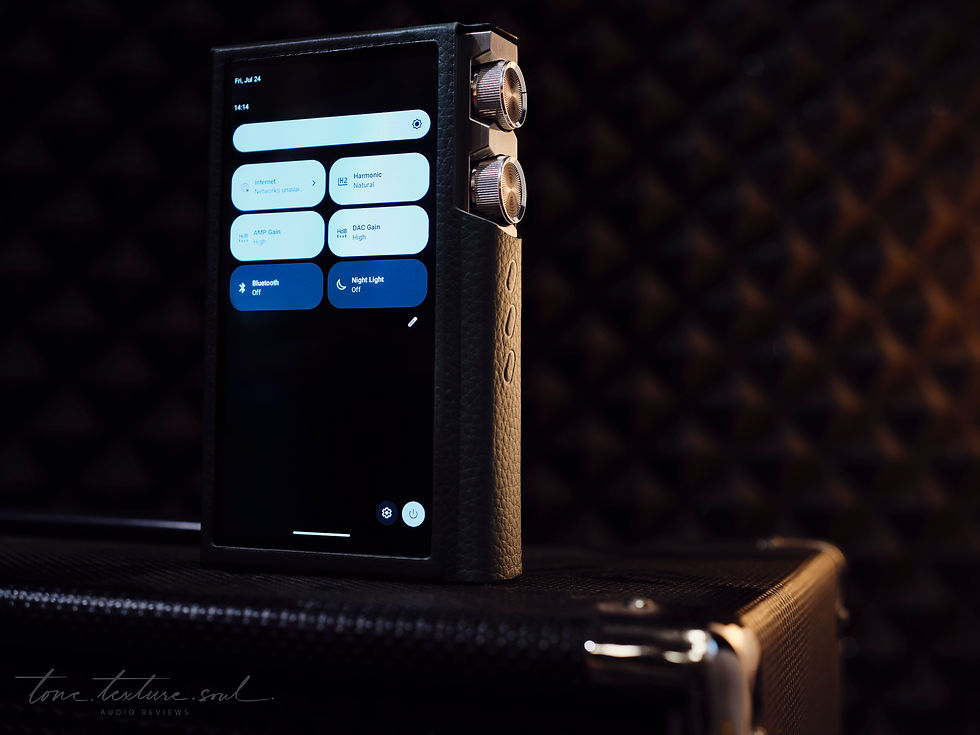
The 340M is a unique-looking DAP. Those fully exposed volume knobs are quite the design choice. I find them fascinating, if slightly flawed in practice. The top knob controls digital volume and doubles as a power button: push to wake and sleep, long-hold to turn off and on. It’s just too sensitive. On many occasions, I found the DAP turned on in my bag, even though I had expressly shut it down before packing. Seemingly any slight bump can activate the exposed button. This is a bit of a bummer. Thankfully, the 340M’s standby time is near-endless, and you can set an auto power-off in the settings.
The lower knob is analog volume. The stepped attenuator returns and has the same soft clicks and stepped volume output as the 320M. Unlike the soft and slightly wiggly 320M attenuator, this feels super solid and tight. It is a joy to use; the steps feel correct, and there is very little play. Occasionally, I hear one side cut out if I land in the middle of two steps, but it’s far less frequent than on the 320M. A teeny wiggle gets you going, no problemo.
For those unaware, using a stepped attenuator in lieu of standard volume control is a choice made for minimum sonic loss. Instead of a volume knob digitally controlling the volume, here what you’re turning is the actual volume itself. This affords perfect channel balance at any volume. I’m used to this kind of thing from my desktop amps and previous use of the 320M, so no big thing. If this is your first source with an attenuator, it will take a bit of getting used to, especially with more sensitive IEMs.
Speaking of which, the 340M solves the issue of wanting a volume between two steps, something I ran into often with my Trailli Ti and other sensitive IEMs. One step was too quiet, the next way too loud. The physical digital volume knob—a control previously buried in the DAP settings—gives you nearly endless control over tiny adjustments. Between each analog step, you have 100 digital clicks to find that magic volume. Cool, right?
The issue is that you’re controlling the DAP’s digital volume to do this. Lowering it (technically) lessens the signal—you’re losing information, fewer 1s and 0s. For a DAP to use an attenuator to maximize SQ, only to use digital volume for fine-tuning, is a catch-22. In reality it sounds great, it’s useful and allows comfortable volume with any IEM. I rarely touch it, as the analog steps give me enough control for my listening levels. You can turn it off completely in settings if you wish.
CHASSIS
Using titanium is a great choice. It’s stunning, light and (if you believe in this kind of thing) imparts its solid and neutral qualities to the sound. The 340M is a really nice design, leaving that ugly brick behind (sorry, 320M) and going for a giant slab vibe instead. Being less deep than before, it fits one-handed much better. The screen is far bigger, brighter and more pleasant to use than before. What it lost in thickness, it more than makes up for in width; it’s a chonky piece of gear. Angles are sharp and clean; the titanium has a very raw look that is simultaneously polished. It does show fingerprints more than the 320M’s finish did, but it’s much nicer all around. The titanium on the back has a more brushed finish, sitting next to the glass—a striking look.
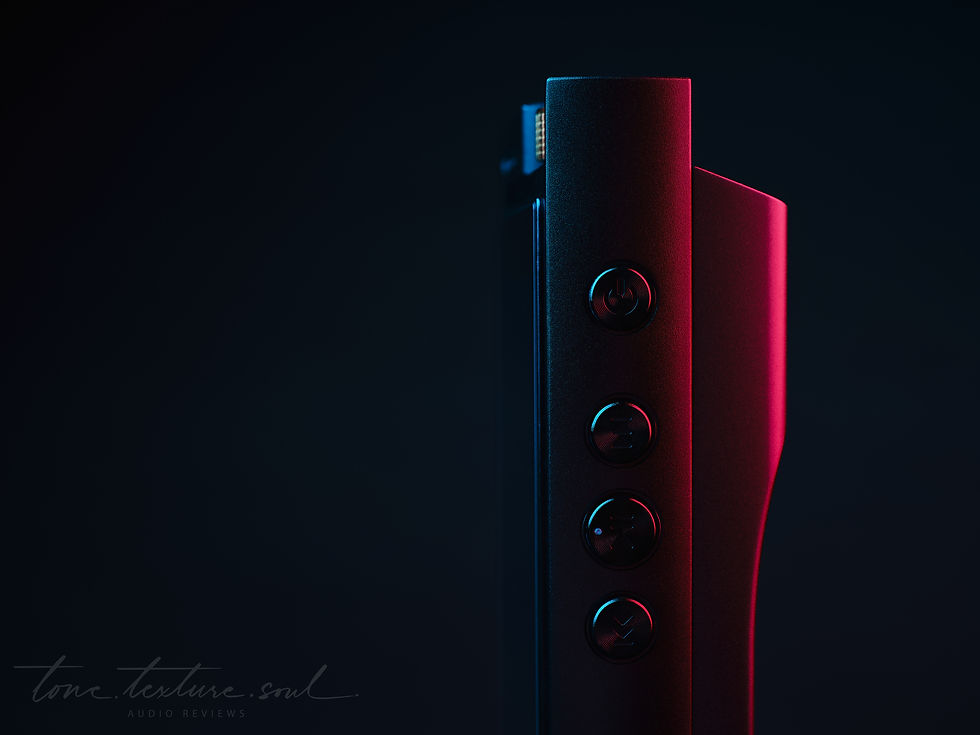
The 340’s infamous design aspect is that ledge across the right side, jutting out with the volume knobs and control buttons. It’s distinctive, unique and ultimately divisive. Love it or hate it, you can tell it’s the 340M by silhouette alone. The physical play buttons have a nice click to them and look very classy. I personally turn them off all the time; I prefer using the screen. In hand, it feels like a big DAP with an extra piece on the side, and that’s okay. It’s not like the GT2 with its ledge-gate; this doesn’t inhibit inputs or controls, and serves a purpose. It’s big and heavy, but the huge, nearly bezel-less screen more than makes up for it. The screen is also crazy bright—not modern-cell-phone bright, but for most of us who listen inside, it too bright at the maximum setting.
On the bottom, you have the USB-C charging port, SD card and SPDIF jack. On top, you now have the outputs, moved from the bottom in previous iterations. This is a welcome change; it allows the DAP to be in a pocket or bag while listening. I put it in my back pocket often, and this is great. You can also slip the screen in settings. You have PO outputs in 4.4mm and 3.5mm. A dedicated LO in 4.4mm is also great, though some may wish for a 3.5mm option, which isn’t selectable via software either. Then there’s the DC input charging port, strangely placed at the top instead of next to the USB-C charging port on the bottom. I was told this is because it’s the shortest circuit path possible and therefore offers better, purer SQ—that’s up to you to decide. It’s weird to charge, as you have cables coming out of both ends. But since you shouldn’t charge the DAP while listening, you would never have that dual-cable issue while playing.


INSIDE
Let’s take a look at what iBasso has listed on their website specs (edited for brevity):
Next Generation MAX Series Flagship Digital Audio Player
Discrete 1bit Architecture with 160 PWM-DACs
SoC + Audio DSP + FPGA-Master 3.0
Four Batteries, Two Battery Management Systems
Analog and Digital Volume Controls
Discrete 1bit Architecture With 160 PWM-DACs
The DX340MAX, as the ultimate evolution of the DX340, has been further enhanced from the original 128 discrete PWM-DACs to an impressive 160 PWM-DACs. The number of PWM-DACs is more than eight times that of other portable discrete DACs devices. This is not just an increase in quantity but also a more stringent requirement for clock precision and algorithm scheduling.
Through a complete overhaul of the circuit design and wiring optimization, the entire device's AP measured THD+N as low as -122dB, which is comparable to desktop DACs using 1bit architecture priced at 13,000 USD. For discrete 1bit architecture, the mountain is high, but the summit has been reached.
FPGA-Master 3.0
The DX340MAX is equipped with FPGA-Master 3.0 technology, which is built on years of in-house developed algorithms by iBasso. The new FPGA chip has 7.5 times the number of LUT logic units compared to version 2.0.
FPGA-Master 3.0 serves as the main audio controller, directly requesting audio data from the SoC. It is paired with two Accusilicon femtosecond oscillators with the phase noise as low as -158 dBc/Hz@1kHz, achieving fully synchronized single-clock operation.
Leveraging the powerful performance of the new FPGA the DX340MAX incorporates numerous new algorithms for even and odd harmonic adjustment, resulting in rich overtones and more distinctive sound characteristics. Increasing even harmonics makes the sound closer to that of a tube amplifier, while increasing odd harmonics adds more passion and vitality.
SoC + Audio DSP + FPGA-Master 3.0
Some players, to simplify and lower cost, implement audio DSP functions by simulating DSP algorithms within the SoC using software decoding. To thoroughly resolve this issue, the DX340MAX is equipped with a dedicated professional-grade audio DSP chip. Thanks to this DSP's exceptional 192dB dynamic range and -174dB THD+N, it can achieve perfect audio conversion, while significantly reducing the load on the SoC.
Driving With Precision & Mastery
A key upgrade in the DX340MAX over the AMP18 is the addition of a dedicated differential buffer amplification stage, which is composed of two operational amplifiers with a CMRR (Common Mode Rejection Ratio) of up to 120dB, that achieving full differential transmission.
The DX340MAX features a balanced output impedance of only 0.9Ω and a single-ended output impedance of just 0.4Ω, allowing it to deliver both powerful dynamics and delicate details simultaneously.
Open System + Closed System, All-in-One
Using the Android 13 system and supporting installation of streaming APPs, you can enjoy the convenience of the Android system. The DX340MAX bypasses Android SRC system-wide at the software level, allowing both Mango Player APP and streaming APPs to enjoy system-level “Non-SRC” features.
Product Information
Price
$3,699.00
Internal Specifications
CPU: 11nm Octa-Core Qualcomm Snapdragon 665 SoC
Operating System: Android 13 and Mango Player
Supported Formats: APE、FLAC、WAV、WMA、ACC、ALAC、AIFF、OGG、MP3、DFF、DSF、DXD、and DST.
Internal Storage: 8G RAM, 256G ROM
External Storage: supports SDXC and SDHC Micro SD cards up to 2TB
Battery Life: 17.5 hours (The play time varies with different resolutions, volume used and headphone/IEM loads
Charge Time: 3 hours for the digital section battery and 2 hours for the AMP section battery pack
Weight: 1.3lbs
Inputs and Outputs
Analog Audio Outputs: 4.4mm Balanced Phone Out,4.4mm Balanced Line Out, 3.5mm Single-ended Phone Out
Digital Audio Outputs: 3.5mm Coaxial Output, USB OTG Output
Wireless Connectivity
(WiFi/Bluetooth)Bluetooth V5.0
Wifi 802.11a/b/g/n/ac(2.4Ghz/5Ghz
Output Power
4.4mm Balanced Phone Out:
THD+N:-115dB(600Ω LOAD)
-115dB (300Ω LOAD)
-110dB (32Ω LOAD) 4Vrms
Dynamic Range:122dB
SNR: 122dB
Crosstalk:-126dB
Frequency Response:10Hz-40kHz-1.5dB
Output Impedance:0.9Ω
Output Level:6.45Vrms@32Ω(Battery Powered)
8.48 Vrms@32Ω(DC-IN)
Output Power:1300mW+1300mW@32Ω(Battery Powered)
2250mW+2250mW@32Ω(DC-IN)
4.4mm Balanced Line Out:
THD+N:-122dB(1K/44.1kHz/24bit,4Vrms)
Dynamic Range:123dB
SNR: 123dB
Crosstalk:-125dB
Frequency Response:10Hz-40kHz-1.5dB
Maximum Output Level:4Vrms
3.5mm Single-ended Phone Out:
THD+N:(1K/44.1kHz/24bit,0.5 Vrms)
-104dB (600Ω LOAD)
-104dB (300Ω LOAD)
-105dB (32Ω LOAD)
Dynamic Range:121dB
SNR: 121dB
Crosstalk:-118dB
Output Impedance:0.4Ω
Output Level:3.16Vrms@32Ω(Battery Powered)
4.27Vrms@32Ω(DC-IN)
Output Power:330mW+330mW@32Ω(Battery Powered)
570mW+570mW@32Ω(DC-IN)
Being an absolute fringe-level audio chaser, I can call out minuscule changes in frequency and timbre with authority and experience. With under-the-hood tech, while I understand it, I won’t try to quantify the specs, instead focusing on how they affect the sound.
A ton of ideas from previous iBasso DAPs went into the 340MAX, and they were further optimized and refined. Instead of the ROHM DAC in 320M, it now has the same 1 bit discrete DAC used in the smaller 340 but a ton more chips. Refined FPGA, clock, oscillators and power supply - all improved.
An impressively low output impedance of 0.9Ω (BAL) and 0.4Ω (SE) means dynamic swings and ultra-hungry IEMs are well-fed, with power (and current) in reserve. Dynamic range is 122dB, for big macro dynamics. SNR is 122dB, which results in a perfectly inky-black background where microdetails pop out of space.
Still using the same 665 SoC, so don’t expect lightning fast UI, though it is far better than 320M. Some stutters are to be expected, but in general it’s smooth. I found the battery life to be improved over the 320M, with the digital side needing recharging about twice as often as the analog, depending on settings. I could listen for a few hours, a couple of times a day, and only charge at the end of the second day - which for most people is more than enough. Charging is also fairly fast.
This DAP is a specs beast. Transportable DAPs of late strive to bring desktop-level sound to the portable market. I won’t say the 340M is the best DAP available, because subjectively it’s not, but I will say it has the most desktop-like presentation of any DAP around now. Especially when using the 12V DC input. I don’t mean the sound quality, simply the presentation.
I always use high gain for DAC and amp, as I find it the most dynamic, regardless of the transducer used. Zero hiss, zero noise, just an endless black void, even with CFA Clara.


POWER
340M is very powerful. Up from the 320M’s 1250mW, we now get 1300mW+1300mW. This doesn’t translate into double the power in use, but it does mean the headroom and sense of hold and grip are clearly felt. Using battery power, the 340M powers STORM with SS8 cable at a lower setting than the 320M, and with more headroom and power in reserve. Any IEM will feel dynamic and powered to its full potential. Some full size headphones will be more than happy with this; others may feel flat or lifeless, as expected from a DAP.
Plug in the DC input and you’re almost doubled at 2250mW+2250mW. Without adjusting the volume pot, you gain a few dB, while reach, stage, headroom and positioning improve by a large margin. Note weight, hold, control, detail and overall presence increase massively. The treble is more refined, and that slightly metallic lower treble is a distant memory.
In this way, it really does feel like a desktop rig.
There is more power than anyone could ever need for IEMs, and from what I’ve read, it can power the Susvara or 1266 with ease.
That’s CRAZY.
To confirm this, I plugged in DC power, set everything to MAX—pardon the pun—and, using local files, demoed three testing tracks. Using the same files on an SSD plugged into my Matrix NT-1, into my Mola Mola Tambaqui DAC and SAEQ Astraeus amplifier, I spent a few hours going back and forth with STORM.
While not on the same level sonically—obviously—the headroom and staging were only a bit behind, which was a big surprise. Detail was similarly behind. I’m not saying the 340M was equal to my desktop rig. Absolutely not. But it was nonetheless very impressive from the point of view of presentation.
I could see headphone folks traveling with this and wanting for not.
SOUND
This is a great DAP.
An amazing one, even.
For most audiophiles, the 340M may be endgame. Game over. And that’s awesome. The DAP market is so saturated with high-end stuff right now, it comes down more to taste than pure performance. That’s a wonderful thing for us as buyers; I can’t remember so many summit DAPs at one time before. Instead of choosing “the best one,” now we can choose “the best one for my tastes” while remaining top-tier.
Of course, some DAPs do push for that last 5%. As a self professed lunatic for the final few percent, we’ll keep that in mind as we move forward.
340M has a vast, detailed sound. It’s bombastic and energetic. The stage is massive, the bass deep and powerful. Mids are set back a bit and err on the warmer side, being smoother while staying resolving. It has good note weight, feeling dense and full. Transients are quick and clear, sometimes slightly over-accentuated. This can be adjusted in settings via harmonic profiles and interpolation modes.
There is a slight bump in the lower treble, not unlike other iBasso offerings, and this amplifies the energetic personality. Treble is extended, revealing and lively. The stage has outrageous width and depth, but less height. Overall, it’s an exciting, thunderous and intense listen.
Extreme PRaT.
It’s not so energetic that it sways the music. If you’re listening to something quiet and beautiful, it can be breathtaking. But more energetic music will certainly feel the 340M’s push.


BASS
It’s like desktop bass, cemented and solid. All around you, it blew me away on first listen. It is boosted, and that presence is felt. Not overly bassy, but not reference either. Similar to Lotoo’s GT2 in many ways, but bigger and fuller. Deep sub rumble, more midbass kick and thump, adding to the energy and pace. Bass is fast. Kicks hard. A solid foundation for the entire presentation, rooted. I’ve rarely felt such power and control from a DAP.
The only issue is texture: it can, on occasion, be somewhat plasticky, like BA versus DD bass. It’s fast, punchy and endlessly controlled, but lacks a bit of that air and textured rumble that is so satisfying. An IEM with BAs further amplifies this; with a proper DD like HEX or Ventura, it’s much less apparent.
MIDS
The mids are big, powerful and nicely weighted. Much more so than the 320M, with a bit more musicality and less reference. In terms of texture, I hear the mids as having two aspects. The body is full but not rich—slightly smoothed, a bit warm. The edges are very clear, very defined and resolving, and that combination takes some getting used to. The A&K SP4000 also has smooth mids, but smoothed edges too, which I found rather bizarre against the rest of its lively presentation. I was always reaching for the volume, trying to get the mids to clear up. The 340M isn’t like that; it’s very clear and super resolving. Just some mid body can come across as slightly smoothed compared to the transients.
Vocals are big and sit above you. They are perfectly weighted and lifelike. Timbre is great, texture lovely and detail absurd. Male vocals are thunderous, not boxy at all. Guitars and acoustic instruments sound great, though they can occasionally suffer from the two-tone timbral effect I’ve mentioned; body full and smooth; transients fast and clean. Imagine panned electric guitars: the pick edge is sharply defined, but the guitar body slightly subdued. I’m being super nit-picky here, but there it is.
I wouldn’t call the 340M forceful, but it’s certainly not laid back. It feels like it’s calling for your attention, often feeling more proclamatory than refined. What it loses on refinement it makes up for in raw power, ultra detail and energy.
TREBLE
Extreme resolution and highly defined edges. Extended and lively, but not harsh. iBasso have managed a technical high end that avoids fatigue or spikes while remaining energetic and clear. With STORM or Zenith, the details spinning around you are absurd, unafraid to grab you by the horns and shake you. Treble heads and detail lovers will rejoice. It’s not bright, but this is no relaxed top end. What it lacks in that last few percent of refinement, it trades for technical prowess and extension.
Using the DC 12V input the top end is much more open, more refined and micro detailed. I hear the texture being better, the separation more pronounced, and the refinement kicked up a level or two. The stage also opens up in height a great deal, giving the top end room to breathe, with more air and upper-register space.
Panning and subtle reverbs are forward and detailed. Using TET or Annihilator is thrilling. HEX is more open and clear while retaining its signature treble weight and piezo texture. With STORM or Zenith, it borders on intense, but I like it. You can also fine-tune this in the harmonic profiles.


Settings
-GAIN - High gain for DAC and AMP, always. You can relax the mids a bit using low DAC gain, but it changes the presentation too much for me.
-Oversampling - OS I leave turned off, it sounds weird. NOS is too smoothed out. Default is where it's at!
-Interpolation Rates: They aren’t just for transients and detail, they affect the whole spectrum. Smooth has softer treble, more feared mids, and a noticeable upper mid shift. Balanced has more articulate treble but loses the mid focus. Detailed enters artificial territory, unless you really want maximum treble detail. It just boosts the transient edges. Best to try out blind and see which seems the most natural for you.
-Harmonic Profiles - This is great for customizing your sound. You have two tools, odd and even, plus the default “natural”. Odd leans more towards sharper edges and transients, even has more harmonic density and texture. Moving between the profiles you can hear subtle shifts all over the spectrum. I did blind tests for days before settling on my choice of natural most of the time.
MANGO VS ANDROID
One of the selling points of iBasso DAPs is their dedicated Linux-based player that bypasses Android’s limitations and extra processes. Mango is a clean, simple player that does all it needs to do. Play music, local files only. It does this beautifully, with no dropdown menu or gestures of any kind. All the needed settings are there. Bypassing the Android system completely, you get a straight-to-DAC signal. In the same way Lotoo or L&P do it: a local-only player with a stripped-down OS. The unique part of iBasso is its ability to dual-boot at your pleasure, a very useful option. Mango while home and enjoying music on the couch; grab the DAP for your vacation and switch to Android for all your streaming apps.
I do hear a difference between them. Mango is more refined and natural, Android a touch more modern and edgy. There is a blacker background and more refinement in Mango too. I wouldn’t say one is “better”; it depends on your preferences. If you like natural and smoother, Mango. If you like a more modern twist, you may prefer Android boot.
ANANTAR ULTIMATE INFINITY PLAYER
Infinity player is a software mod designed by some crazy wizards bent on squeezing every drop of SQ out of iBasso DAPs. This isn’t something you need an IT guy to do; all it takes is a few minutes and basic skills. It’s non-destructive, and the DAP can always be returned to stock through the auto-installed Magisk app or an iBasso firmware update. I can’t begin to tell you what it does under the hood, but its changes reach deep into the software and hardware, allowing manipulation of the FPGA, DSP and DAC itself. The results are rather staggering, being honest.
Let me be VERY clear: I am not telling you to mod your DAP. I’m not saying Infinity player is approved or official from iBasso - it’s not. I’m not saying you need Infinity player to enjoy the 340M, because it’s fantastic in stock form. I don’t receive any compensation for mentioning this either - it’s free for everyone. If you love it, buy them a coffee.
Infinity makes a huge difference. I was stunned. After weeks with it, I found settings that unlock more of the 340M’s inner potential. And we’re back to this point:
Potential.
Infinity lets you reach for that few percent. Unlocking what might have been in stock form.
Subjective? Yes.
Factual? Yup.
It has two modes. On Android, it appears as another music app, bringing many of the sonic tweaks and fun from its hardcore twin—Infinity Pure. You can use any app and operate the DAP as normal. Bypassing some of the Android pipeline already improves things, much as Mango does: cleaner signal, straight to DAC.
Reboot into Pure and the fun begins.

Now it’s an entire system, local files only. Streaming services like Qobuz work inside Infinity but don’t support downloads. This isn’t the native app; it’s a streaming-only player, and it works really well. Sort of what Astell & Kern did for years with Tidal APK side loading. The design is nice, the UI responsive and well laid out.
You get far more harmonic settings. Many are similar, but one caught my heart—Fire. Newer firmware brought Fire MAX, pushing the mids forward with more presence and weight. I love that. Eventually I built my own, from the ashes of Fire Max comes... TTS Fire MAX!
We get more controls in Pure, notably the boot options that affect the FPGA, kernel and hardware level modifications. These all require a reboot.
- Infinity Stage gives more options for the staging—aside from stock, I found them all weird except for Chamber, which made an immediate and fantastic change. Everything opened up: more depth, better positioning, more air and space between notes. Goodbye flat stage, hello there sphere. I left this one on.
- Infinity FPGA offers three settings: stock, Ultimate and Enjuku. Ultimate was an immediate upgrade in all aspects, especially in dynamics, note weight, detail retrieval, and micro detail. Switching to the newer Enjuku, the DAP takes on a slight change in personality, becoming warmer and fuller without losing detail or technical performance. The choice between these two will depend on the listener, but both are a nice upgrade. Ive had Enjuku on for a few weeks and love it, though it is only available with beta FW.
-DSP has options like Tubes, EQ, Chassis and vinyl emulation. I found them all just ok, except for tubes which is fun. Of course it’s not a real tube sound, but switching on 300B brings an immediate feeling of warmth and mid saturation with more emotion and flow. It’s nice to have, and STORM can be lovely with some added syrupy warmth.
-You also have DSD upscaling, which converts - in real time -all signals into DSD. 256 or 512. I found this more gimmick than useful, you get a drop in volume and it changes the sound too much for my liking.
Overall, Infinity is a cool addition to the 340M’s performance options. Even installing it without further changes brings a system-wide increase. The extra tools let you tailor the sound, and I liked my final results enough to keep it this way. My little grips with stage height a distant memory. For transparency, I moved between modded and stock several times over three weeks to make sure my findings were consistent. I wrote the review using stock, then switched to Infinity and filled in the gaps.
***Update (09.10.2026) With the release of the newest Infinity FW (beta11) the sound quality has improved tremendously. The plastic timbre in the bass is all but gone, mids feel more forward, and I don't have any nitpicks about the body and transients qualities being at odds with each other. Everything is far more cohesive, spacious and grand. If the stock FW came like this I wouldn't have had much to say. ***


COMPARISONS
In a crowded DAP market, several brands vie for the top spot. After exhaustive testing, I have come away with a revelation: it’s all about taste now; there’s no clear “best” choice. Tuning might trump prowess. And that’s a great place to be—we can choose what we prefer without feeling left out.
iBasso DX320 MAX ($3499)
The most obvious comparison to make is the legendary 320MAX, iBasso’s previous flagship. I loved my 320M and only sold it to make way for the 340M. Ultimately I should have waited, as is often the case, simply because the 320M is still fantastic and holds up well. Ive mentioned some differences already, but to recap:
Overall 340M sounds bigger and fuller, scales larger, and has more technical prowess. The sound feels injected with energy and power, dwarfing the 320M’s already massive stage. 320M has more forward and textured mids, slightly less warm than 340M, but less technical and detailed also. More sub bass rumble and texture over 340M’s thunderous midbass kick. Treble is smoother on 320M, though the higher energy of 340M’s top end remains very clear and without harshness. I hear more extension on 340M vertically.
If you love pure reference and mids the 320M still holds up incredibly well. While being overshadowed by the 340M’s increase in most technical and design aspects, I can’t say the 340M is a clear upgrade purely on sonics alone. It’s up to you which you prefer. As a full package the 340M is a big step up, but some may prefer the 320M’s sound.
Evo Aria EVO1 ($6799)
This new company made quite the splash on entry. In no small part based on price: the Evo 1s are nearly $7k each. Based on the N30LE in many ways, they are super impressive. Technical, powerful and ultra-refined. Nu-tubes, several tuning modes and amp stages give you a whole array of options. Keeping in mind they cost twice as much as the 340M, it's a testament to how good the MAX is to go head to head.
The Ti model is a neutral beast. It has huge staging, amazing detail, though its fairly strong V tuning didn’t work well for me. I like forward mids and this just isn’t that. The sheer level of detail and treble extension is wild.
The Cu Copper edition is among the most impressive DAPs I’ve heard in years. Exceptional. But it’s really warm, very thick, and heavy in the midbass. It’s also crazy mid-forward, even neglecting the rest of the spectrum in some cases. With STORM or another neutral IEM, it’s about as good as it gets. Staggering. With warmer IEMs like HEX or Ventura, it becomes too much for me—lacking energy, overdone and smooth. Too much of a good thing. While the detail is amazing and it technically works with all IEMs, $7K is a crazy investment for synergy with only a handful of IEMs. Some bought it just for STORM, and if one wants a perfect portable setup, and has deep pockets, look no further.
A Swiss Army knife all-rounder this is not. I personally can’t justify such a colored and specialized DAP; I need versatility. I prefer to color the sound with IEMs. Sources should be more neutral.
Compared to 340M, the Evos are both more refined. Bass texture is a bit better too. What they lack is a tuning that works for me. Either too warm or too V, there is a glaring hole in the Evo Aria lineup for my tastes. After hours of back and forth, the 340M’s tuning simply worked better, even if it lacked some of the EVOs’ refinement and finesse.
I had my 320M modded by NPAudio, using hand selected components of much higher quality, and the increase in refinement, staging and texture was insane. If the 340M came stock with the same hand-selected components as the Evos, this fight would be much more even. Setting aside that you could buy a 340M and flagship IEM for the price of one EVO (or two 340Ms!) is another conversation entirely.
Cayin N8iii ($3999)
An amazing DAP as well. Essentially an N30LE MK2, it takes everything about the original and refines it, smoothing out the lower-treble bite that offended and giving us a more mature presentation. It comes with a slight V-shaped tuning, which is not ideal for my tastes, but far less so than the EvoTi. I could very easily walk away from DAPs with the N8iii; it’s that good.
Compared to 340M, it’s a warmer tuning, especially if you add the tubes. The level of refinement is even; both have a slight transient edge and minuscule grain compared to the uber-polished Evo lineup. 340M is more bombastic, energetic and slightly aggressive, while N8iii is smoother and more polite. 340M has more midbass punch; N8iii is more sub-focused. Both have good note weight, lively extended treble and grand stages. N8iii is emotive, 340M more neutral and modern. The choice comes down to brand house sound.
Lotoo GT2 ($3200 - REVIEW here)
This is interesting; they have a lot in common. Both are presented as neutral, even reference DAPs, but both sway from that point. Both are bassy, warm through the mids and powerful. Only in comparison did I notice how much more neutral the 340M is. GT2 is a wonderful DAP: thick and dense, with lovely mids and tight bass—a fuller, warmer reference I’ve always enjoyed. Switching to 340M, the presentation is cleaner and less colored. The stage grows in width and depth, bass headroom improves, and mids become more revealing. Treble is similar, though 340M is more energetic. Bass texture on GT2 is better and less plasticky.
Using the 12V DC input, the GT2 is dwarfed in all aspects; the 320M’s overall presentation is much larger and more dynamic. While neither is truly reference, the 340M is certainly more neutral and less colored.
HiBy RS8ii ($3899)
I was quite excited about this one. Given the relatively small form factor, huge power, amazing battery life and ultra smooth UI - and the R2R ladder DAC of course - Hiby’s flagship device carries great potential. Unfortunately I didn’t find it very analog sounding, and the treble was too bright and accentuated for me. I am splitting hairs here, but for a R2R player it was just too digital sounding, especially coming from L&P DAPs like the P6Pro or LP6, even the Quloss MUB5 or Hifiman HM1000 Gold are more natural and analog to my ears.
The sound is clean and clear, but lacks that emotive midrange I love so dearly. I can see how Hiby tried to overcome the “NOS” rolled off treble some complain about, but it’s an overcompensation for me, instead leaving us with a rather piercing top end. In terms of refinement and presentation I think it sits one level below the 340M and N8iii, but that’s just for me.


IEM PAIRINGS
Being fairly neutral, the 340M works with basically everything.
Subtonic STORM
Very desktop-like, especially using the 12V DC input. Great sense of headroom. The ultra-low impedance and high-current swing do wonders; even using the SS8 cable, STORM feels swinging. Massive stage, big notes, very detailed and resolving. Slight tinge of plastic bass texture, but very solid and ultra-taut down to the deepest rumble. Mids are big and weighted; treble is very revealing.
Decidedly more uncolored than Evo1 Cu or N8iii here. Less so than Evo Ti, but more bombastic and less V. More modern than ultra emotive, not relaxed but not harsh either. If you want a more emotive STORM get a Evo Cu, if you want more neutral the 340M deserves some thought.
Mysticraft HEX
One of my favorite pairings. The bass is wildly massive, all around you with no direct emanation point. Slightly over-accentuated in the upper bass, but loads of fun. Great weight, extremely resolving and spacious. Treble feels alive, lacking the muted nature heard with less dynamic sources. Mids are focused and clear, with no added bloat or warmth. Upper mids gain energy but never feel overcooked. With the BlueHour 8W cable, I hear an almost perfectly balanced presentation, full of energy and detail—a far cry from the “stock” HEX sound that brings scrutiny for some.
Very large, desktop-like presentation. Dead silent, which isn’t the case with my desktop rig. I could do with more forward mids, but that’s purely personal and subjective.
Symphonium Zenith
Another cool pairing. A STORM-lite vibe, lacking the weighted mids and extreme detail of its big cousin, but fantastic nonetheless. Excellent extension on both ends, very detailed. With the SS4 cable I found it moving towards the STORM, with fatter notes and a more analog vibe. Swapping to Nightcraft Selene brought a more massive stage, big thick bass and brighter more modern mids.
If you prefer a stock Zenith sound the included cable works well. Being nearly as power hungry as STORM the 340M powers it with ease.
Dita Ventura
Amazing. The Ventura can be warm and emotive or rich depending on source, and I am happy with the 340M’s more neutral tuning here. Mids are smooth, but ever so detailed, and never syrupy. I always forget I'm listening to a single DD with these, especially paired with the 340M.
The staging is absolutely bonkers, and Ventura’s slightly softer edges are intensified by the 340M’s transient attack and added PRaT. Treble is very extended, and the entire presentation is truly grand. Balanced and vast, this leaves nothing wanting.
CFA Clara
I use Clara for background noise testing, and the 340M doesn’t disappoint. Perfectly black, absolutely devoid of noise. Hooray! For this kind of power, that’s quite a feat. The MAX’s added energy and transient response give Clara a more adventurous presentation, less mainstream and smooth. Great bass. While I enjoy Clara for relaxing sessions and photo shoot studio setup time, it can feel a little underwhelming. The MAX brings a welcome step up in dynamics and energy.


CONCLUSION
I spent more time testing the 340M than any other piece of gear in recent memory. During my weeks of testing, my opinion of MAX changed over and over. Out of the box it was a bit funky, but that changed quickly and keeps improving. The more I listen the better it gets.
We’ve never had so many summit DAPs to choose from, and in all of that noise, nothing squelches the 340M. Some have more refinement, some better mids. Some are more neutral, some have tubey goodness. Some arguably sound "better", but lack the extreme power or the 340M's fabulous array of parlor tricks and tuning options.
So is the 340M perfect?
Nope.
The best choice for me?
Indeed.
And that’s saying something.
What iBasso have given us is a fantastic DAP. Immense power, a real desktop like presentation. A technical marvel. A DAP that trails the GOATs in very minor ways, and based more on taste than performance. For many, it really is the end of the line, and deservedly so. There are things to improve—there always is- and Anantar is a big step toward that potential. Maybe further firmwares from iBasso will bring new goodies to the table. I sure hope so!
Other DAPs talk a big game, but the 340M is far more than the sum of its parts. And in this moment, it is hard to beat for what it does.
I wish to thank Paul from iBasso for sending me this unit, for his patience, and answering all my questions. The new MAX deserves a spot at the top, even if just shy of the gold medal. For the price, it deserves my highest recommendation, you have to spend double to get a few percent more. And for many, it's just as it should be - I'm the ultra picky type.
This is what a review is for: not to focus on what it isn’t - but more importantly, all that it is.
Thanks for reading!