
Final TONALITE TWS IEM RevIEW - Bring On The Music
Updated: Aug 22
Breaking the mold of TWS, TONALITE brings timbre-accurate personal tuning and top-end sonics to the masses. Housed in a lightweight, textured matte black shell, TONALITE is anything but common. It may well represent a new pinnacle in wireless audio.

Pros
-DTAS tuning is real
-Shell is small and light
-Great ANC
-Articulate, dynamic and immersive presentation
-Small case and great battery life
-LDAC is best, but AAC still sounds fantastic.
Cons
-No pressure venting
-Treble can be peaky without the stock hybrid foam tips
-LDAC cutouts and connection issues are a major drag
-Price (though justified)
Greetings, dear friends and fellow audio nerds the world over. I bid you welcome to my newest review and—for the first time—a true wireless IEM: the Final TONALITE.
I've never really been into wireless audio. I'm a hardcore, old-school "sound quality above all else" kind of guy. Until recently, my one and only TWS experience was my trusty pair of Apple AirPods Pro 3, bought purely for travel. They sound good, the ANC is amazing, and their cocoon of silence has saved my sanity on countless trips while I globetrot for my photography work.
It never really crossed my mind that a TWS could work for serious music listening.
At a local audio meet, a friend and fellow reviewer introduced me to the TONALITE. He couldn't stop raving about it. He put me in touch with Final, who very kindly sent me a review sample. They arrived, and a few songs later, I understood why.
Final uses something they call DTAS (Digital Twin Audio Simulation), and it's one of the most interesting things I've encountered in portable audio. Using an app, you scan your ears, then work through a guided process that tailors the timbre to both your ear anatomy and your personal preferences. This isn't EQ, and it certainly isn't some gimmicky collection of factory presets. Final understands that every ear is different, every listener has different tastes, and even our perception of timbre varies. After the setup DTAS gives you several personalized tuning profiles based on your ears and your choices, allowing you to switch between them at any time. This is as close to a personally designed sonic presentation as I’ve ever encountered.
TONALITE just might be the last TWS you ever need. Priced at $329 they aren’t cheap, but they best the competitors in spades, and they’re yours down to the tuning.


Their sound?
Amazing. Not a true wired experience of course, but they have shaken my core beliefs that only a full IEM experience can touch my soul. That I can genuinely enjoy music, get lost in my music, on the go.
Deep bass, realistic mids, clear treble and an expansive stage create a truly top-tier wireless experience. ANC is excellent too. While it doesn't quite reach the black-hole silence of the APP3, it's more than capable of pushing the outside world into the background.
The downsides?
There are two.
The first is the lack of pressure venting. For a single dynamic driver, it's a strange decision. I do experience pressure build-up, although the supplied hybrid foam tips solve most of it.
The second is LDAC. When it works, it's phenomenal. When it doesn't... it can be maddening.
Walking around, putting the phone in a pocket or bag, or simply moving too far away results in cut-outs and connection issues that would drive a Zen monk crazy. I was told it's a limitation of the chipset, already being pushed to its limits by DTAS processing. I understand the reasoning, but for a flagship TWS whose biggest selling point is high-resolution wireless audio, it's a significant compromise.
Thankfully AAC sounds surprisingly good, and I suspect many people won't feel they're missing much. But LDAC is better—and once you've heard it working properly, you'll want it to work all the time.
Despite its flaws, it feels like a genuine step forward in wireless audio.
I've spent time with offerings from Sony, Technics and several others. And they can all give great sound and an immersive audiophile experience.
As someone who almost exclusively reviews flagship and summit-fi gear, it might come as a surprise that I'm reviewing a TWS at all.
TONALITE is different.
DISCLAIMER AND TESTING DETAILS
-I received TONALITE directly from Final Audio, it is mine to keep. I was never asked for anything beyond my honest feedback and impressions.
-I review because I love doing so. No one pays me for reviews, ever. If I recommend something, it’s because I genuinely loved it and think you might too.
-I’m a small boutique shop. These reviews take a huge amount of time, so I focus on gear that genuinely interests me — things I’d personally want to own. Please keep that in mind.
-I start with a varied playlist of testing tracks to form initial impressions, then spend several weeks listening naturally to whatever inspires me. Before writing, I return to those testing tracks once more. I also listen to the gear while writing the review itself.
-To form an honest opinion, I think it’s necessary to test with lots of different music. If you’re taking a reviewer’s word about a piece of gear, in my opinion, you must take into consideration how their musical tastes match or differ from your own.
IEMs used for comparison: Apple AirPods Pro3, Technics EAH-AZ100, Sony XM6, iFi GoPods Air with CFA Clara.
My ever-evolving testing playlist HERE


Packaging & Build
TONALITE comes in a small white box containing the IEMs, charging case, stock tips, plus the headband and AR stickers used for the DTAS setup. Simple and to the point—no ridiculous summit-fi packaging here.
The charging case is small, lightweight and closes securely, though it doesn't lock. There's also plenty of room to use aftermarket tips, which is a nice bonus.
Both the shells and charging case share the same textured matte black finish. It's understated, fingerprint resistant, and feels great in the hand. After months of touring with them, being thrown into camera bags, backpacks and pockets, they've held up remarkably well. Apart from a little dust collecting around the removable canal seal, I haven't noticed any wear at all.
The shells themselves are incredibly light and have a nicely sculpted ergonomic shape. The front reminds me a little of the Alien head from Ridley Scott's films, with the pointed end resting above the tragus rather than disappearing deep into the ear. Two sizes of included concha seal rings are included too, if you have small canals and larger ears they make for a more secure fit. Final's own photos suggest they're designed for a shallower insertion, and that's exactly how they fit me.
Despite that, comfort has been excellent. I can happily wear them for hours without discomfort.
Controls & ANC
Apple still has the best control scheme in the business.
The haptic squeeze on the AirPods Pro stems is brilliant. You never accidentally pause your music while adjusting the fit because every command is a deliberate squeeze.
Like almost every other TWS, TONALITE uses capacitive touch controls. They work well, but they can still trigger accidentally while adjusting the fit or putting them in your ears. Thankfully, Final's implementation is about as good as I've used, with a gentle vibration confirming every successful press.
Controls are simple: single tap for play/pause, double tap for next track, triple tap for previous, and a long press switches between ANC and transparency mode. My only complaint is the lack of an "off" mode. At home I'd often prefer neither ANC nor transparency while moving around the house. I’ve been told this might be possible with a future firmware update, but we’ll see.
ANC itself is very good. It's not industry-leading. Heavy aircraft engines and nearby voices still make their presence known, but it's more than capable of creating a peaceful listening environment.During the recent summer heatwave it completely erased the fan beside my desk and most of the traffic outside my apartment.
The London Tube... Not so much. Still, it's a trade I'd happily make for the jump in sound quality over the APP3.
Pressure & Venting
Pressure build-up is probably my biggest ergonomic complaint, and I still struggle to understand why Final chose not to vent the driver.
I asked them directly, their explanation was fascinating. The decision was made to preserve sub-bass performance. They even sent me THD measurements showing how the exceptionally low distortion allowed them to remove the need for venting while maintaining cleaner, deeper bass.
Technically, I understand the reasoning. In practice, I'm not convinced. Just because one can, doesn’t mean they must.
With silicone tips I experience noticeable pressure build-up. Especially since when touching the haptic buttons inevitably you worsen the pressure by pressing inwards. Switching to the supplied hybrid foams solves most of the issue, but those same foams don't seal quite as tightly, meaning I lose a little of the sub-bass the design was intended to preserve.
That's only my experience, of course.
Ear anatomy plays a huge role here, and many people may never notice it. Even so, it's one of the few design decisions that left me scratching my head.


DTAS (Digital Twin Audio Simulation)
This is quite something.
When I first read about the theory behind DTAS, I was very skeptical. In my experience, adding DSP science to audio rarely brings a true leap in sound. More often than not, it feels like another paper-based technological advance rather than something you genuinely hear. I'm not dissing DSP. It absolutely has its place in products like DAPs, Roon or HQPlayer.
But in a TWS?
I expected little more than generic EQ presets. Bass Boost. Pop. Jazz. The usual settings that completely murder an IEM's personality.
This is not that.
I won't get into the science here—there are others who can explain it far better than I can. Instead, I'll simply tell you what happened.
Out of the box, TONALITE sounds like any good TWS. Pair them, hit play and you're greeted with a clean, neutral and surprisingly technical presentation. Great detail, a much more audiophile tuning than most mainstream offerings.
DTAS changes the game.
Before touching the app, I deliberately spent a week listening in the stock configuration. I wanted to understand the baseline before changing anything. Thankfully, a recent firmware update has streamlined the entire process. What once took close to an hour can now be completed in around fifteen minutes. You photograph your ears while wearing the supplied headband and AR markers, upload everything to Final's servers, and then begin selecting your preferred timbre profile.
This is the part I'd encourage people not to rush.
Play your own music. Take your time.
This isn't about choosing the biggest stage, the strongest bass or the most exciting presentation. It's about timbre. That took me a little while to understand.
I found myself listening almost exclusively to vocal realism, acoustic guitars, pianos, violins and cymbals. Sometimes a profile sounded smoother, others more metallic. Sometimes note size changed, while transients became softer or quicker. The upper mids seemed to be where the biggest differences appeared.
You could very easily choose a profile you end up disliking if you focus on the wrong things. The end results vary so much that they can genuinely sound like two completely different IEMs.
But, when you get it right they're extraordinary. The stage becomes larger, deeper and more solid. Notes gain weight. Detail improves, both macro and micro. Dynamics become more convincing. Most importantly, instruments simply sound more believable.
That's when I stopped thinking about DTAS. I just started listening to music.
Choosing Your Profile
Once the process is complete, the app gives you three versions of your personalized tuning: Reference, (-) and (+).
In general, (-) leans smoother and slightly bassier, while (+) is brighter, leaner and pushes the lower treble a little harder. I found myself spending most of my time on the Reference setting, occasionally moving to (-) depending on tips or mood.
Speaking of tips, changing them alters the presentation far more than I expected, enough that I'd recommend revisiting the DTAS profiles if you decide to tip-roll afterwards. Or best, spend time with them and tip roll before doing the DTAS setup so you’ll have a baseline.
If it helps explain the general direction—and speaking very loosely—Reference reminded me of Final's wired IEMs. Minus leaned a little towards Sony or DITA Ventura’s smoother sound, while Plus moved closer to something like Faith Labs E1000 top heavy detailed packed vibe. Those comparisons are extremely broad, but they should give you an idea of just how much DTAS can alter the presentation.
Overall, DTAS is real. Not a gimmick. And the improvement over the stock tuning is enormous.
LDAC
I'm constantly amazed by how good a Bluetooth connection can sound, whether it's feeding a TWS like TONALITE or a DAC/amp such as the Quloos MUB5. It's like a blanket is lifted from the music, revealing detail, space and natural timbre while stripping away many of the digital artifacts we still tend to associate with wireless audio.
When LDAC is working, TONALITE sounds phenomenal.
Leave your phone on a table nearby and you're rewarded with a wonderfully clean, high-resolution presentation that genuinely rivals some wired setups. Then you pick up your phone. Or put it in your pocket.Or your bag. And the cut-outs begin.
Sometimes they're minutes apart. Sometimes nothing for half an hour. Other times they're a relentless barrage of skips and dropouts that completely pull me out of the music. If I were to list the quickest ways to ruin a great listening session, connection instability would be right at the top.
It's maddening. Whether or not this matters to you is personal. Thankfully AAC sounds remarkably good here, and you're not giving up nearly as much as I expected. But LDAC is still the better codec. It brings more detail, more natural timbre and removes that final layer of digital haze.
I asked Final about this too. They explained that DTAS pushes the chipset extremely hard, and maintaining a completely stable LDAC connection simply wasn't possible with the hardware they chose. I understand that. I just wonder whether sacrificing a small amount of DTAS processing in exchange for rock-solid LDAC reliability might have been the better compromise. That's a trade-off I'd happily make.


Sound
I genuinely think TONALITE is one of the best true wireless earphones I've heard.
Products like Noble's Fokus range or the iFi Go Pods paired with a good IEM can still surpass it in outright sound quality, but they do so at a much higher price while giving up ANC and many of the conveniences that make a TWS so enjoyable to live with.
TONALITE sits in a very different place. More than once during this review I caught myself forgetting I was listening to a TWS. That's probably the biggest compliment I can give it. The presentation is natural, detailed and clean without sounding sharp, artificial or forced. It leans towards neutrality, favoring realism over the warm, consumer-friendly tuning that dominates much of the TWS market.
DTAS takes that foundation and makes it personal. That, more than anything else, is what separates TONALITE from everything else I've heard.
Bass
Tight, punchy and wonderfully tactile.
The emphasis is clearly on texture and control rather than quantity. It reaches deep when asked, delivering satisfying rumble while remaining disciplined and articulate, avoring speed over rumble. Different DTAS profiles noticeably change the bass character too. Some become fuller and weightier, while others tighten things up and prioritize speed.
Midrange
For me, this is where DTAS earns its keep. I have yet to hear another TWS with mids this detailed and textured. They're quick, neutral and wonderfully articulate, with enough resolution to satisfy even demanding audiophiles. Transients are fast, note weight sits comfortably in the middle, and vocals have a wonderfully natural presence that I immediately appreciated. Most importantly, I never hear the upper mids trying to draw attention to themselves. Everything simply sounds clean. Honest. Real.
If you're after lush, euphonic mids you'll probably want to use DTAS to nudge things in that direction. Or this might not be the IEM for you, they’re just not that sound.
Personally, I found the honesty refreshing.
Treble
This remains my one real criticism. The treble is wonderfully extended and packed with detail. The amount of air and openness Final has managed to extract from a TWS is genuinely impressive.
At times, though, it can become a little too enthusiastic. Rather than a narrow peak, I hear a broader region of added energy that occasionally gives cymbals and percussion a slightly "plinky" quality. Thankfully, tip choice makes a significant difference.
Switching from Final's silicone tips back to the supplied hybrid foams tamed it considerably. The character never completely disappears, but it's much less noticeable. Combined with the right DTAS profile, I suspect many listeners won't be bothered at all. For my ears it's the one part of the tuning I'd still like to see refined.
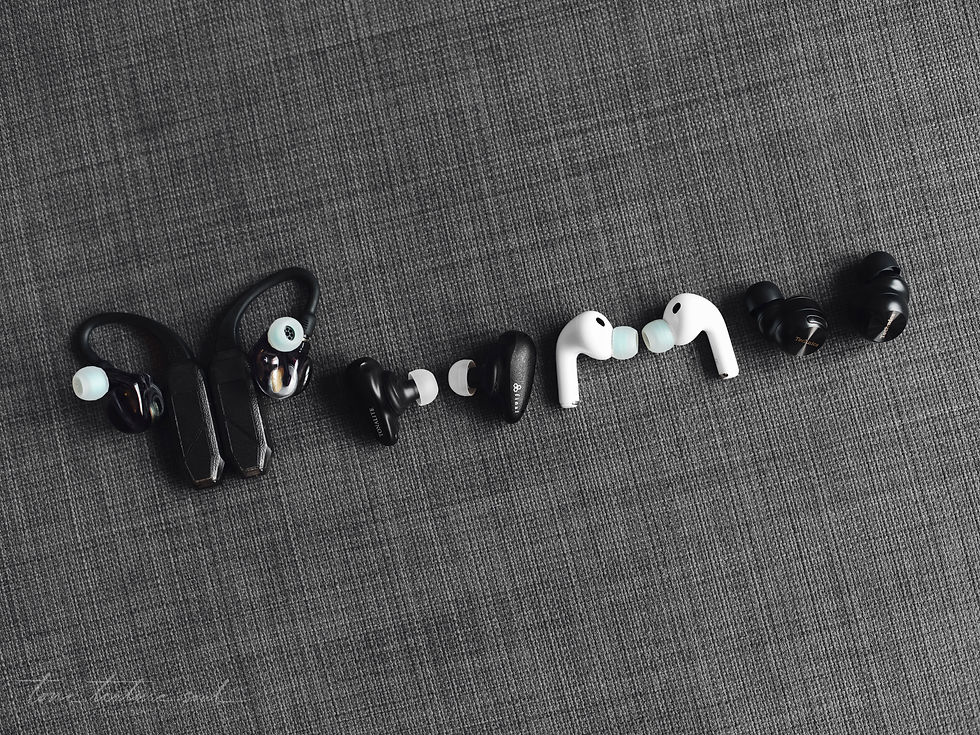


Comparisons
Apple AirPods Pro 3 ($279)
My very first TWS, and still the king of convenience.
Using some kind of science wizardry, the ANC on these is untouchable. It's like a black hole—you pop them in and disappear from the earth and all its annoyances. That's the reason I bought them, and they absolutely deliver. Spatial Audio for Netflix is fantastic too, calls are crystal clear, and switching between Apple devices remains completely seamless.
For music, not so much.
The tuning follows a fairly consumer-oriented V-shape. Bass is enjoyable and the top end is impressively open, but the mids are simply too lean and lack realistic weight and timbre. They'll get me through an airport lounge, but since receiving the TONALITE, I honestly can’t use them for music anymore.
The lack of LDAC is the final nail in the coffin for me. Apple has done an excellent job with AAC, but LDAC is simply on another level.
Status GoldenSound ($279)
I just picked these up and what a wonderful surprise.
Tiny, incredibly comfortable, great ANC, and just a genuinely fun TWS to listen to. The combination of one dynamic driver and two balanced armatures produces a lively, detailed presentation with excellent staging and noticeably more midrange weight than the APP3. They trounce the APP3—wiping the floor with them. No chance. I haven't lived with them long enough to make any grand declarations, but first impressions have been extremely positive.
Compared directly with TONALITE, they approach music a bit differently. TONALITE is chasing perfection. Status GoldenSound is the top-end Corvette that blows your hair back on a sunny summer afternoon. I love that. TONALITE is ultimately the more tactile, detailed and technically accomplished earphone. Status is the one that makes you grin.
And honestly, there's plenty of room in this hobby for both. Connection stability on the Status has also been flawless. LDAC locks instantly and stays locked.
Technics EAH-AZ100 ($300)
Another excellent TWS, and one I still happily recommend.
The AZ100 leans warmer, bassier and more relaxed than TONALITE, with wonderfully voluptuous mids that make it immediately inviting. Back-to-back with TONALITE, however, it sounds a touch veiled and overly smooth. Only in comparison. On its own, the Technics remains wonderfully detailed, rich and engaging. The fit is also excellent. They sit almost flush and disappear even in my relatively small ears.
LDAC performance has been flawless throughout my time with them.
iFi Go Pods (Air $249, GOPods $399, Max $599)
Not exactly a true wireless product, but I wanted to include them because they represent something of a ceiling breaker.
Yes, they require your own IEM. Yes, that raises the price dramatically. Mine live permanently attached to the CFA Clara, though I couldn't resist trying them with STORM for a while. How fun is that?
The Go Pods sound exceptional, offering something remarkably close to a wired experience while providing enough power to drive virtually any IEM. It's not really a fair comparison. The amplifier section is physically much larger, the electronics have far more room to breathe, and they cost several times more.
So naturally they're better. Clara on the Go Pods delivers a fuller, richer presentation with greater texture and resolution.
But TONALITE gets closer than I ever expected. Close enough that there were genuine moments where I chose the TONALITE instead—not because it sounded better, but because it was so much easier to live with.
The fact that I'm even mentioning the Go Pods in this review probably tells you everything you need to know about how impressed I was with the TONALITE.

Conclusion
I am thrilled with these. They've become my daily drivers. No more white stems blending in with everyone else, like me, these are unique and match my endless searching spirit.
The ANC is more than good enough for travel, although I do still miss my APP3 on flights. Their cocoon of silence is incredibly rewarding for my sanity. The London Tube recently reminded me how no ANC is enough to protect your ears from those screaming tunnels, but for everyday atmospheric noise, TONALITE is more than enough.
The LDAC situation is genuinely unfortunate. When the cut-outs start, I often find myself reaching for another pair for a while. I understand the technical limitations, but it's still a compromise I'm not happy with.
The lack of pressure venting is another decision I question. Yes, the supplied hybrid foam tips solve most of the problem, but I don't think a flagship TWS built around personalization, and high end audio, should leave me feeling tied to one particular tip. If all ears are different, how can we all be expected to use the same tips?
Lastly, the lively top end won't be for everyone. Thankfully, DTAS gives you more than enough flexibility to tailor it to your liking.
Overall, the Final TONALITE is a revelation. I don't use that word lightly. It's something genuinely different in the audiophile world because it feels like it was designed for us—for the people who obsess over timbre, who spend hours comparing recordings, the SQ addicts, who genuinely care about getting closer to the music. And want it on the move.
Who else would willingly go through an hour long scanning process just to achieve a more convincing sense of realism?
I absolutely commend Final for taking such a bold approach. I think it paid off.
The small frustrations fade surprisingly quickly, and before long I'm lost in my music once again.
Trains.
Planes.
Traffic.
Screaming children.
Bring it on.
I'm not afraid of you anymore.
Bring on the music.
And let it sound amazing.
Thanks for reading! A big thank you to FINAL and especially Kyo for answering all my questions, even drawing diagrams for my education.


