
Arctand Cables Review - Purity Unleashed
Hailing from Singapore, this one man show makes some of the finest audio cables in the world. Pushing sonic and design limits, and unbelievable attention to detail, Arctand brings the epitome of purity, expression and transparency to your music.

Pros:
- Shocking transparency and musicality
- Exquisite sound from all price ranges
- Celestine² is the finest interconnect I’ve ever heard
- Rubi² is supreme summit level
- Obsidian² is class leading value with amazing sonics
- Well made, well designed, simple and elegant
- Flexible and light
- Top end hardware
- Available in XLR, RCA, USB, POWER, Speaker, and DC Power
- For TOTL cables they are quite “affordable”
Cons:
- Sonically nothing
- Price of Rubi² and Celestine² (even if warranted)
Welcome dear friends and music lovers to my newest review, the family of Arctand Cables. While most of my work has been covering portable audio, after the birth of my AFI project, (Amps For IEMs) I’ve gone deep into desktop gear for my listening enjoyment when tethered at home. I love portable audio, I travel all year and it’s saving my life and sanity. But nothing compares to running a top-end IEM through a desktop rig; that magic isolation and closeness, with the unbridled power and staging makes for an insanely potent mix.
I built a crazy monster system for IEMs, yes, I’m that into it.
I’m far from the first to do so, but it has converted a large portion of my listening time. In fact, it’s changed my whole idea of IEMs and music consumption in general. So much so that I suggest anyone who needs the absolute pinnacle, this is the way to do it. It started with my reviews of headphone amps: the Zähl H1, the SAEQ Morpheus and Astraeus. They made my ears sing and my heart soar.
I never looked back, there was no going back.
I was hooked.
I’m primarily an IEM listener; on the road or at home, I prefer their isolation and presentation. Headphones don’t have a place in my life right now. I’m no beginner when it comes to stationary cables; I have great affinity for speaker systems, and my vinyl collection would surely make the inner nerd in you guffaw and wow. The main reason I got into portable in the first place was to bring my vinyl with me on tour. A great DAP and IEM is plenty for me to enjoy endlessly while traveling, out and about, or walking in the woods late in the evening, serving its purpose of injecting my soul with music and salvation. When I want to go full throttle, at home I have my monster system, tuned and tweaked to its last breath.
I realize some might find it silly to write a review on ultra high-end desktop cables for IEMs use, but I respectfully disagree. Using my rig with IEMs is nothing less than a spiritual experience.


After many reviews of portable cables, I knew what I wanted my rig to sound like, but where to start? The world of summit 2-channel is dizzyingly expensive, cables for $50K are everywhere, and a fellow could get destitute if not careful. At the suggestion of my dear friend Chang from Nightjar Audio, my sonic Yoda, he introduced me to his secret weapon, Darren from Arctand. The most unassuming guy; a soft spoken 23 year old Singaporean native, moonlighting bass player, finishing up his electronic engineering degree, and an audio purist of the highest order. Darren, I love this guy; his passion and excitement rival mine which is hard to do. Speaking like a blend of seasoned craftsman and NASA engineer, this young lad easily melds his inner ultra-nerd with youthful exuberance: he calls me Bro, and uses fun neon dancing emojis while explaining physics and wire geometry like it's Goodnight Moon.
Yes, I’m the baby in that scenario.
His ideas on audio purity make me think of a quote from Buddha, such is the depth of his yearning for sonic purity and perfection.
"Three things cannot be long hidden: the sun, the moon, and the truth."
-Buddha
DISCLAIMER AND TESTING DETAILS
- All the cables used in this review are demos. They remain the property of Arctand and will be returned upon completion of my time with them.
- I review because I love doing so. No one pays me for reviews, ever. I review things that interest me, things I would buy for myself. If I recommend something, it's because I genuinely loved it, and I think you might too.
- I start out with a varied playlist of testing tracks to form my initial thoughts, then spend several weeks listening to whatever inspires me, as I normally would. I come back to the testing tracks before sitting down to write.
- To form an honest opinion I think it necessary to test with lots of different kinds of music. If you’re taking a reviewer’s word about a piece of gear, in my opinion, you must take into consideration how their musical tastes match or differ from your own.
- I had the entire lineup of Arctand to test:
-Celestine² USB + RCA
-Rubi² USB, RCA + XLR
-Obsidian² USB + RCA + XLR + Power + XL Power
-Onyx Speaker Tap-XLR Adapter
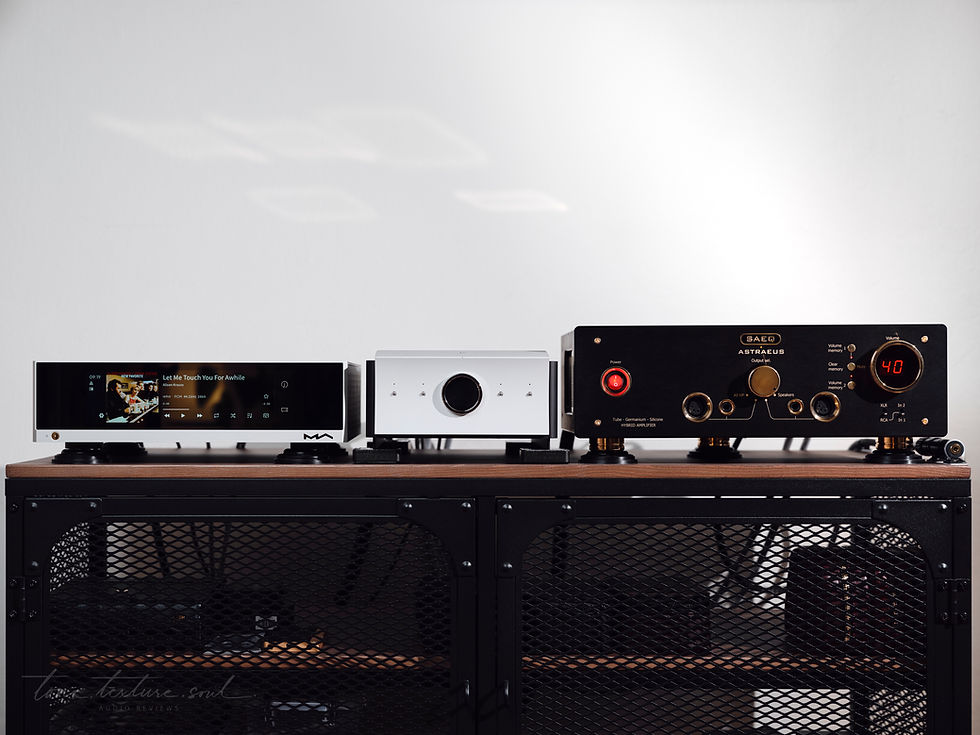
- Desktop chain: Matrix NT-1 Streamer > Mola Mola Tambaqui DAC > Zahl H1 or SAEQ Astraeus Amp. Furutech power conditioning.
- IEMs: Subtonic STORM, Mysticraft HEX, Dita Ventura, Symphonium Zenith, Elysian DIO, Oriolus Traillii Ti, CFA Clara, 64A 18t.
- 2 Channel: Roon > Weiss DAC 204 + Modwright LPS > Lab 12 Pre1 > Arcam P85 > Dali Ikon 5. Vinyl is a modded Rega PL3.
My ever evolving testing playlist HERE
To Be Clear: Before our introduction I had never heard of Darren or Arctand. While I call him a dear friend now, this is after nearly a year working on this review. I got to know his mind through thousands of messages that stretched into the early morning; the guy barely sleeps. When I find someone who encompasses what I feel in my heart about audio, I sign on for the whole deal. I can pick anything from the lineup and it speaks to me deeply. Arctand is that for me, and this review is a testament to Darren’s work.


Arctand intro
In September 2025 I found myself in Singapore and arranged to finally meet up with Darren after several weeks of texting. When I walked into the coffee shop, I realized I had no idea what he looked like. Sitting at a table was this kid; I almost didn’t believe him when he came over to say hello (I’m pretty easy to spot, covered in tattoos and grinning like an idiot). After small talk, we got right into gear. The way he speaks about audio is akin to a mad wizard who comes out of his basement every once in a while with a new creation that changes the world. Arctand is his personal creation; he’s one guy. There is no factory, it’s all handmade, all by him. The attention to detail, the insane levels of complexity, the endless pursuit of perfection—it’s his alone. We had coffee, a couple pieces of cake to share, and we’ve been good friends ever since.
THE LINEUP
At the time of writing Arctand has three lines:
Obsidian² - The ‘entry’ level
Rubi² - The top end
Celestine² - The summit
Calling Obsidian² entry level is a silly thing to say. It is indeed priced that way, for high end cables they’re super affordable, but don’t think they’re basic. Sheathed in black, Obsidian² is unlike any entry level cable you’ve ever heard.
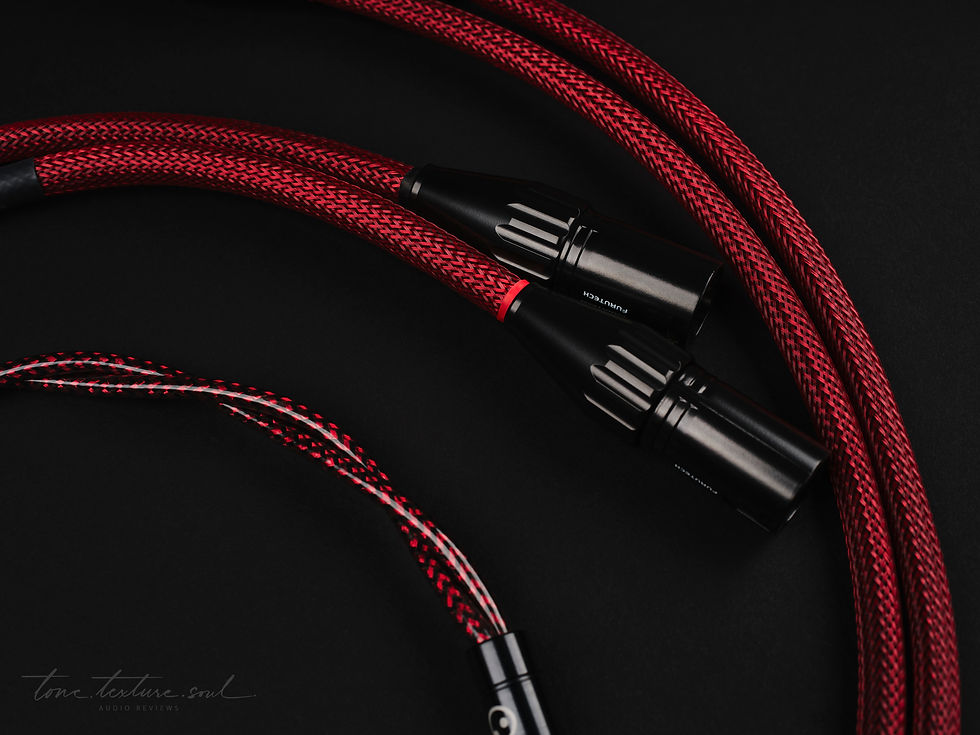
Rubi² takes it up a notch or two, bigger staging, more resolution, more energy, all keeping that same solid foundation. Rubi² trades blows with any high-end desktop cable I’ve heard, it’s tremendous. Sheathed in bright red, Rubi² is THE flagship cable in every aspect of the word. You’d be hard pressed to find better for 5x its price.
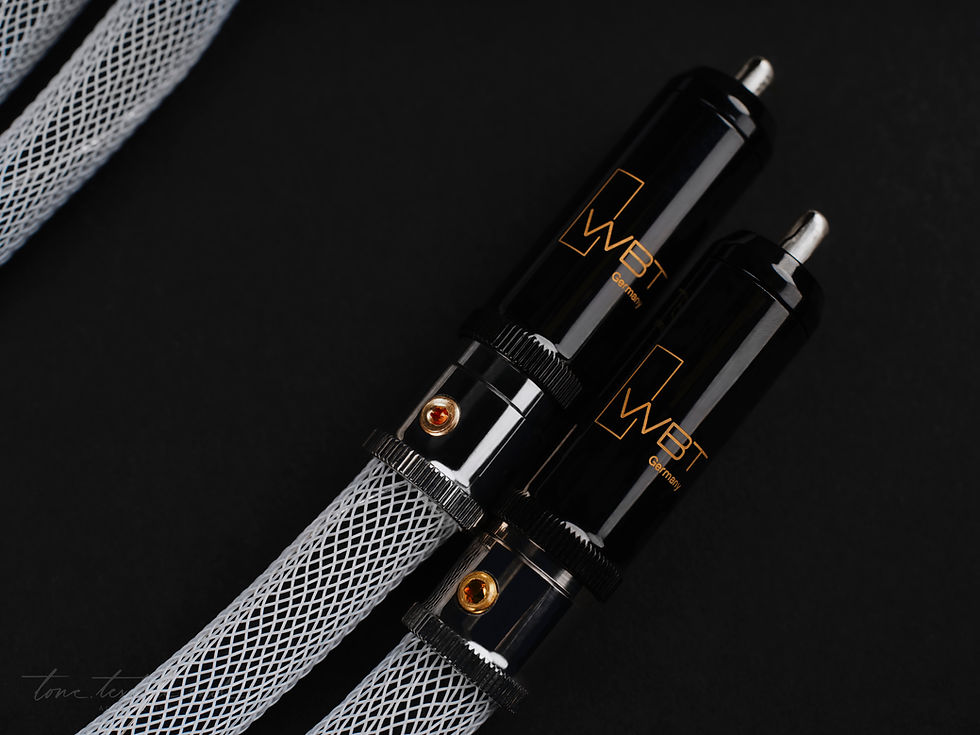
Celestine² is another world, breaking concepts of what a cable can do, and how it does it. Insanely resolving. Full and powerful. Exceptionally transparent, redefining realism. Sheathed in white, this OCC-A silver cable is the finest cable I have ever heard.
Cables and Prices
To be clear up front, I am a cable believer. If you don’t feel the same please feel free to read something else, this review won’t be of any interest to you. I’m talking about expensive cables, these are no Mogami XLRs, or your uncle’s HiFi system. Nor are they the exotic ridiculously expensive fodder you’d find in a Hi-Fi boutique or at a show being ogled by the lawyers and doctors who can afford them. This is not that at all. These are handmade, exquisitely designed and sonically crafted, but their prices are realistic. ICs around $300 for Obsidian², $1000 for Rubi², and Celestine² around $3500 is an unbelievable deal for this level of sonic prowess. Yes, $3.5k is a chunk of change, but Celestine² is god level. On every price level Arctand is smashing the playing field.
The Obsidian² Power cable took my previous entry level leader Shunyata Venom and dumpstered it. The Venom is a great cable, Obsidian² is just better.
Being clear, when I say entry level I’m saying so in terms of high-end cables. Obviously you can get good cables for much less, but to get into the top end game, at this pricing, is extremely competitive.


BUILD
All Arctand cables are very well built, with a clean and flattering design. Besides color-ways and hardware choices to differentiate the lines, if you didn’t know you’d be hard pressed to know which is which. The higher up the build, the thicker the cable, but just barely so. This is to say that every piece looks the part, the Obsidian² lineup looks and feels as top end as its pricier siblings. The design language is consistent and well thought out. The sheathing is clean without bunching up, no folds, wrinkles, or imperfections to speak of. They are all slim enough not to be awkward, flexible and soft with a touch of silkiness. They feel good in hand, and look fantastic plugged in. Some high end cables go for extremely thick and unwieldy designs that can even pull on your components, Arctand just lies in place proving a summit cable doesn’t have to be enormous. They’re also not flashy, like a handmade piece of art over some glitzy marketing pull.
Nice hardware, upgradable as desired. Solid connections, no play or wiggle. They go in with a very satisfying click that feels solid. I particularly like the Furutech options; they sound incredible, and you know what they say about Japanese engineering. The Celestine² RCA I have uses German WBT pure silver connectors, which are considered by many to be the finest RCAs money can buy. They have the benefit of tuning by the user; you can tighten or loosen the black barrel to alter the sonic performance, which I’ll get into later.
SOUND
"Glass is the very symbol of transparency and non-attachment. If your windows are cloudy or dusty, your mind will become cloudy as well."
-A Monk's Guide to A Clean House & Mind
Audio transparency is often associated with cold and clinical, an overtly reference projection of music run squeaky clean and without emotion. This is simply not the truth.
Darren’s entire philosophy stems from removing the sound of the cable—its coloration and effect—and letting the system breathe on its own, with great emphasis placed on realism, transparency, and utter musicality. During our chats he would talk about the cable industry; he felt there was far too much energy spent on tech specs and measurements with not enough listening. Or only listening and emotion, forgoing the science, leading to colored sounds that mask and “fix” issues instead of bringing them to light for analysis or adjustment. The magic is in the balance, something I deeply feel in my heart—not only for audio but life in general. While color has its place, Darren prefers using components to tailor the sound, while cables remain uncolored and deeply resolving.
In this case uncolored doesn’t mean cold, sterile or flat - quite the opposite. Arctand cables are hugely musical, they flow and sway.
Darren’s focus on realism is the chef’s kiss. Oftentimes overlooked in favor of extreme resolution or air, Arctand’s cables have the most realistic and “live” sound of anything I have tried. They are forward, upfront and tactile, while remaining extremely spacious. I am inside my music, it lives in me, I can reach out and touch it.
I am the music.
Isn’t that what it’s all about?
Throughout this review I’ve included pieces of my conversations with Darren. I was so inspired by the way he speaks about sound—part engineer, part philosopher, always a musician—that paraphrasing him felt like losing something essential. His voice is part of the Arctand story, and I wanted you to hear it for yourselves.
And yes, he really does speak like that! Magician meets astronaut. 😁
A CONVERSATION WITH DARREN
TTS: Arctand describes itself as a preservation company, rather than a traditional cable company. What does that distinction actually mean in practice?
Darren: Most cable companies operate essentially as tuning companies: they sell a sound, whether it be warmer, brighter, or more spacious, and they will call that sound natural, musical, or revealing. Instead, what I do is preservation.
Preservation means that the signal arriving at your amplifier is as close as physically possible to the signal that originally left your source. I’m not interested in providing a different version or a compensated version, but rather the recording exactly as it was performed, captured, and intended. The cable's job is to remain causally invisible, and when it achieves that, what the listener discovers is not a preferred coloration but the source itself. So I believe in a fundamentally different, and far more honest, relationship with the equipment.


Obsidian² — The Awakening
According to Darren:
Many of us hear a cable as part of the system rather than in isolation. Its coloration can become entangled with what we attribute to the amplifier or speakers, until the cable becomes an uninvited co-author of the experience.
Obsidian² is designed to remove that co-authorship. It doesn’t strip away the intention, texture, or character of the recording; it removes the cable’s own degradation. Musical articulation becomes clearer, attention returns to the source, and within a minute the cable should begin to disappear. For me, that is where Discover Your Sound begins.
Tech detail | Geometry and Makeup
Conductor: 6N OCC Copper (99.9999% purity), 24 AWG.
Geometry: Starquad, 4-core shielded geometry.
Dielectric: PTFE, chosen for its low electrical noise and stable insulation properties.
Shielding: A dense braid over the quad geometry, providing noise rejection compounded by both geometric cancellation and the physical shield itself.
Outer diameter: 6 mm standard / 4.5 mm variant (No Sleeve)
In varied lengths, interconnects fall in the $300 price bracket, while prices for their speaker and massive power cables go in the $590 range.
For more information, please visit HERE


According to me:
Obsidian² are shockingly good cables, regardless of price. Being entry level as they are, I would say confidently they’re the best value desktop cable available today. Obsidian² is very resolving and transparent on its own, and represents Arctand’s level of prowess.
Staging is 3D with excellent width and height, depth is good too. It’s an even presentation, everything seems in its place and very natural. Notes are naturally weighted without being thick, attack and decay are precise without being forceful or etched. Bass is punchy, though doesn’t reach as low as the higher siblings, placing more emphasis on punch. Clean is a word that comes to mind when listening to Obsidian², though not in a clinical or dry sense at all. Treble is finely expressed and extended, without seeming harsh or bright at all. There is a small accentuation of the upper midrange to add presence, and tiny it is. Unlike pinna gain in an IEM, this subtle addition bears mentioning only while adhering to the dedication to neutrality and transparency Arctand stands so fervently for. Overall the Obsidian² sounds clean and clear, and is a remarkable achievement.
Moving to power cables I feel Obsidian² demolishes the competition in this bracket. Switching from Shunyata Venom I heard an immediate and astounding upgrade in every aspect. Stage became far wider, taller and especially deeper. Detail was more pronounced, the background was cavernous and pitch black. Micro detail and textures were far more apparent, and the overall sensation was a rich, detailed, and extraordinarily high-end presentation. Switching to the XL power cable was like unleashing a wild dragon. More in all directions, with the stage reaching full 3D holography. Texture, detail, clarity and tautness were upgraded tremendously, and the feeling and realism were vastly improved. I was astounded.
I would go so far as to say the Obsidian² power cables, especially the XL, are the best upgrade I’ve done to my system. Instant buy, zero regrets. If you can handle the extra size and double price, the XL is best in show. For the money this is gangbusters. Darren’s other lineups have power cables coming, I can only imagine.


Rubi² — The Refinement
According to Darren:
Once a system is already balanced, the goal is no longer to change its sound, but to uncover more of what is already there. For me, Rubi² is the definition of musical precision: greater articulation, deeper imaging, and microdynamic texture, while the cable itself becomes less relevant.
When I designed Rubi², I wanted a complete, engineered cable that could also deliver musical gravity and engagement within a single listening window—before critical analysis takes over. Its Quadex Starquad geometry and precisely calibrated blend of OCC Copper and Silver are there to preserve that information, reject noise, and maintain a black background. In a way, Rubi² marks the threshold between high-fidelity as an aspiration and high-fidelity as an ongoing practice.
Tech detail | Geometry and Makeup
Conductor: OCC Copper and OCC Silver, 18 AWG effective gauge, featuring cryogenic preparation and grain selection to meet aerospace-grade conductor standards. It uses Hybrid² stranding, which means OCC Copper and OCC Silver come from different factories and are carefully adjusted at the conductor level.
Geometry: Quadex Starquad, Arctand's variation of Starquad which places four conductors in a quad formation to minimise transmitted magnetic fields; this structure yields lower inductance than twisted-pair or flat geometries and serves as a low-loss geometry that preserves modulation depth across the run length.
Impedance: Flat characteristic impedance is stringently maintained from the cable body entirely through the connector interface, eliminating the reflection artefacts at transitions that typically smear transients.
Dielectric: PTFE
Shielding: An OFC braided shield combined with a finely tuned filtering implementation on the ground termination; this avoids the detrimental side effects of over-shielding.
Grounding: The VGround system, custom-tuned specifically for analogue output-stage circuits, applies differing electrical length ratios across all grounding nodes to achieve broadband resonance rejection above 1 MHz.
Capacitance:
Connectors: Premium low-noise connectors built to tight mechanical tolerances, featuring low contact resistance and impedance-stable pins.
In varied length, prices for interconnects range around $1000.
For more information, please visit HERE

According to me:
Rubi² represents the finest cable you can buy for a reasonable price in the top end tier. There will always be crazier options, far more expensive and with wilder materials and constructions, but Rubi² sounds fantastic. Astonishing performance. Resolution and detail are summit level. Compared to Obsidian², transients feel faster and more articulate without being sharpened or altered in terms of texture, or timbre. It’s not brighter, there’s just more there, unmasked and unveiled. It stages huge, with surreal top end extension. I would often lean back in my chair because I was trying to “see” the details far above my head. Like an IMAX theatre, the surround sound and spectral clarity is superb. The depth is particularly impressive, and decay is tighter and more firmly held in place while allowing room to breathe and flow. Bass is bigger, deeper and more textured, punch is also improved. It’s still super transparent, but the bass has more authority and class. Mids are fleshed out, feeling closer and deeper at the same time. Here we begin to see Darren’s secret sauce coming to the surface; bigger, closer, thicker and more meaty, while gaining space, air and detail at the same time. Rubi² does this to fantastic levels, Celestine² takes this aspect and rockets it into outer space.
Treble is very refined, airy and articulate. It’s also more resolving, taking a few minutes to adjust coming from Obsidian². While Rubi² remains very transparent, I do hear some slight emphasis and attention placed on the treble. It’s not bright, it’s not sharp or altered, but placed ever so slightly forward. Grabbing attention, not forcing it. Some of the finest high end I have heard, allowing my Mola Mola Tambaqui’s exquisite treble to shine unlike any cable I had tried before. Analog and delicious. Decidedly Hi-Fi, effortless in its refinement, Rubi² stands tall among any and all contenders. $1000 for an IC may seem like a lot, but it’s a bargain for one of the best in the world at any price.
Throughout my testing I was always impressed with Rubi²’s abilities, not only on the technical side, but how musical it remained. Whether in my desktop rig, or moonlighting in my 2 channel, their expressive nature and gratifying musicality was always deeply satisfying. Guitars were poignant and detailed, vocals floated up front and center with lushness and vivid emotion. Drums and cymbals were vibrantly energetic, and the lack of staging ceiling never ceased to amaze.
TTS: Is this “cable problem” fundamentally a measurement issue, or is there something deeper at play?
Darren: I view it as something much deeper: an ontological error about what kind of problem audio reproduction actually is.
The measurement culture that has dominated this industry for decades tends to treat audio reproduction as a spatial, static problem: we map frequencies onto a flat plane, find the deviations from flat, correct them, and then declare the system done. Frequency response gave the industry a falsely legible endpoint; achieve the target curve, stop asking whether the source is still audible through the result, and call the problem solved. There is simply no apparatus inside that framework for the question that actually matters most: is the source still the most relevant thing in the room?
I believe the correct framing is that audio reproduction is a temporal, relational problem. The source signal is not a spectral snapshot but a continuous, modulating, temporally rich event defined by its envelope, its modulation depth, its microdynamic texture, and its phase relationships between frequency components across time slices. Frequency response captures where energy is distributed in a steady state, but it cannot capture how the signal 'moves.' I’ve found that a cable can measure perfectly flat while simultaneously compressing transients, smearing the decay of a piano note, and raising the noise floor enough to lose the low-level harmonic texture in a vocal performance. All of that damage is invisible to traditional FR analysis, yet it is directly audible to the trained listener as lossy.


Celestine² — The Reference
According to Darren:
The engineering required to serve the soul of a recording becomes more rigorous because it demands that I understand and define the right parameters through lived experience.
Measurement and listening are never opposed. I see them as two projections of the same underlying object, and insisting we must choose between them is a false dichotomy.
For example, when looking at ‘High-Fidelity’ through a multivariate lens, the story becomes quite different. While frequency response, harmonic distortion, and a clean noise floor are fundamentally necessary, they describe steady-state energy distribution, and not so much whether a fast drum transient arrives with its ‘shape’ intact, whether a vocal or an instrument’s microdynamic texture survives the cable run, or whether the imaging depth a recording contains is actually reaching the listener through the representation of a recorded medium.
Therefore, Celestine² gracefully ends the relationship between the listener and the cable, leaving behind only the system as it actually is: the electronics' own character, the speakers' tonal signature, the room's acoustic behavior, and the recording's imperfections and intentions held in equal and complete measure.
For a system that has been built honestly, this provides the clearest and most revealing window I can offer; conversely, for a system that is relying on cable coloration to compensate for underlying failures, Celestine² will unavoidably make those failures audible.
Done right, you will be left with an experience of the source material—what it was always supposed to be.
Tech detail
Celestine² is built around OCC-A Silver conductors that are annealed to a stress-free crystal structure using aerospace-grade conductor standards, elegantly combined with the Hybrid² weave geometry to control the electromagnetic field at every point along the cable. Our VGround grounding system applies differing electrical length ratios across the ground pathway, attenuating the stray RF and standing waves in the signal ground plane that raise the noise floor in conventional designs. The CM-1 composite shield compound achieves what we call a truly dark background: a noise floor clean enough that what the listener hears is the source itself, not the environment the cable is operating in, all while flat characteristic impedance and low-loss geometry ensure that modulation depth is preserved from the first centimeter of cable to the last.
Geometry and Makeup (Analog Prototype)
Conductor: OCC-A Silver, 16 AWG; annealed to a stress-free crystal structure, meeting rigorous aerospace-grade conductor standards, and grain-selected to ensure minimum resistance variance across the entire production run.
Geometry: The Hybrid² weave controls the electromagnetic field across the conductors for the entire audio range; it is designed to minimize loss and keep the sound quality consistent throughout the cable.
Impedance: Flat characteristic impedance is maintained seamlessly from the cable body through the connector pin interface, ensuring zero reflection artifacts at critical transitions.
Dielectric: Premium PTFE, carefully tolerance-selected to ensure dielectric absorption remains effectively immeasurable at audio frequencies.
Shielding: 100% foil coverage paired with a 95% braid, integrating the CM-1 composite compound on the grounding pathway to provide a dark background without the loss of fine high-frequency detail.
Grounding: The VGround system, specifically tuned for analog interconnects, utilises differing electrical length ratios to attenuate stray RF and standing waves in the signal ground plane.
Capacitance: 35–50 pF/m
Connectors: Ultrasonic precision-fitted connectors crafted from a copper-silver alloy; contact resistance variation is held to an exacting ±1 mΩ, ensuring they are impedance-stable from the very first insertion.
Build: Constructed entirely in-house from raw materials, with every unit individually tested against Arctand's exacting electrical performance standards.
Voicing tolerance: Zero; any deviation from measurement-flat is considered a production failure, not a design choice.
Geometry and Makeup (USB / Digital)
Data conductor: OCC-A Silver featuring a precisely controlled twist pitch and Teflon insulation; the strict 90-Ohm impedance eliminates signal reflections, inter-symbol interference, and jitter.
Power geometry: An OCC Copper Starquad arrangement reduces emitted noise and ripple by up to 40 dB when compared to standard unshielded power runs.
Grounding: The VGround system employs differing electrical length ratios to reliably attenuate stray RF and standing waves within the digital ground plane.
Ground shield: The CM-1 composite compound ensures a dark noise floor without sacrificing delicate fine detail.
Connectors: Premium copper-silver alloy connectors featuring impedance-stable pins.
Celestine² is currently offered only in digital configurations, in varied lengths starting at $3,000. Analog interconnects remain prototypes at the time of writing and are available only by request.
For more information, please visit HERE


According to me:
When I first plugged in the Celestine² RCAs, I nearly fell out of my chair. I’ve had in mind a sound, for years I searched for it, yearned for it, to no avail. I like a big presentation, full and dense but extremely detailed and resolving. Big staging and density a misnomer. To my dismay the more I searched, the further away I ended up. With everything I tried the extra resolution gave way to a thinner sound with less body and weight. Staging size, especially height were also solved by a thinning of the upper spectrum, leaving the realm of realistic and entering a space that felt impressive initially but left me wanting. My preference for forward mids was met with overly intimate staging, congestion, dullness and feeling claustrophobic.
Celestine² manages to do away with all those negative aspects, and offers a pristine, full, rich, dense and weighted sound that is as massive and spacious as it is resolving. Absolutely mind melting. Beyond anything I have ever heard, truly. In the portable world we have the Nightjar Sovereign Symphony IEM cable, it too stages massively, its big notes sway my heart to glee. Very transparent, very revealing, very detailed. I hold it as the finest IEM cable ever made, and to no surprise, the Celestine² IC holds the same title for me.
Celestine² bass is big and bouncy, rich and textured, or fast and punchy. There is endless reach with the finest decay; rumble is wildly satisfying. Given its transparent nature, Celestine² bass is a chameleon, portraying what the track calls for with endless control. I don't hear more bass quantity, but it feels fleshed out, more thunderous and emanating from all directions. Surround sound—the sub reach feels like live music, with incredible texture. It grabs my heartstrings, wrangles my guts into a knot of anticipation and desire. Everything I tried, from IEMs to speakers, Celestine² infused laser-like precision into the bass, while giving it all the room it needs to ebb and flow. I have never heard bass like this; it's truly remarkable. My Mysticraft HEX's low end was undeniable—from the deepest pulsing electronic sways of Om Unit to Moses Yoofee Trio's Roman Klobe-Barangă throbbing sub melodies. Avishai Cohen's texture-rich percussive stabs or Justin Chancellor of Tool—mind-blowing.
Mids are so incredible. Vivid and detailed, musical and exceptionally real, you feel inside the music. Timbral accuracy is wildly impressive. They are forward and huge, while remaining the most spacious and engaging I have ever encountered. This is mid range at its finest. With STORM or HEX the sensation of scale was off the charts, I have never heard an IEM presentation that big, that powerful. The level of macrodynamics is simply another world. With endless grace, the finest wisps of micro details and bombastic drum hits presented with equal poise, control and clarity. So dynamic! Vocals float above and all around you. Voices sit in your lap, almost to the point of claustrophobia, simmering in their liveliness and emotion. I struggle to explain the scale in which the Celestine² presents in the mids, the detail is beyond anything, the size overwhelming, without a shred of forcefulness, compression, or heavy handedness. They are alive, emotive and deeply dynamic.
Treble is weighted, fast, articulate and effortless. There is ample sparkle and air - it's so natural, flowing and elegant I could never say energetic, or spritely - overused terms that fail to capture the essence of what I hear with Celestine². The treble is alive, it flows and dreams. It has impact, a well placed snare knocks me back in my seat with weight and percussive power. Nothing ethereal or lifeless, this is as close to reality as I've ever heard in audio. While endless, the extension is lifelike, not grossly exaggerated. While Rubi² is a touch taller, Celestine² has no emphasis or attention grabbing qualities, the whole image is otherworldly and massive, liquidly placed into a mesmerizingly cohesive and musical package. You can forget about anything you think you know about silver—Celestine² smashes concepts to powder, expectations are exceeded, dreams come true.
It may sound like hyperbole, but I tell you, this is the sound I always dreamed of. And it’s even better in person.
Guitars are paramount to my music, and nothing sounds like Celestine² guitars. They are full, powerful, weighted and full of grunt and texture. I hear them mixed center and panned wide at the same time, engulfing me, transfixing me. Vocals are larger than life, mouth shape and micro details are beyond exceptional. The finest details are preserved and held close, while endless decay and reverbs echo off to infinity in all directions. Drums bounce and slam; especially the snare, which has far more body and impact than with other cables. Kick drum decay has such depth I couldn’t believe the trailing echo’s retention of texture and character. Rubi² stages massively, one of the largest I have ever heard, but Celestine² is another level.
TTS: You said Celestine² could make some systems sound worse. How is that possible?
Darren: When a system has been built or tuned over time around cables that add warmth, body, or softness, removing that intermediation will naturally expose the system's actual character. Electronics that measure slightly bright will sound bright. A bass-heavy room mode that was being partially masked will become clear, and a recording with hard-sounding close-mic drums will sound exactly like that recording.
The listener's first instinct may be to attribute this new harshness to the cable, perhaps concluding that Celestine² doesn’t suit their system. I would say the cable has simply stopped compensating, and the system is now audibly diagnostic—exactly as it is. That can be extremely valuable, because it tells the listener where to look next: the electronics, the room treatment, or the speaker placement.
A cable that reveals the truth of a system is far more useful than one that comfortably conceals it.


USB CABLES
Even for the most ardent cable believer, USB cables are sure to cause arguments and criticism. How could a digital cable make any difference, it’s only transmitting 1s and 0s! I always felt the same, it just makes no sense to me on a technical level.
I’ll admit I have left that idea in the dust, upon hearing what Arctand USB cables can do, they’re now one of the biggest upgrades I have made. How? Implementation is the key!
In order to do a decently scientific test I procured a few basic and mid-level USB cables to compare. From Amazon cheapies to DDHiFi, Luxury & Precision WP1+ and AudioQuest, then Arctand all the way up the line. The difference was staggering. Not subtle at all. Not only going from a measly $3 to $50, but even as I moved through higher-end options from $100 to $800, the results remained consistent. A jump to Celestine²’s $3000 price tag throws diminishing returns to the wind.
Yes, a $3K USB cable, preposterous!
But, the Celestine² USB is now one of my most cherished pieces of gear. Like I can’t live without it, and they will have to pry it from my cold dead fingers! It sounds ridiculous to say, I am well aware, but it’s the truth.
"When you realize nothing is lacking, the whole world belongs to you."
— Zenful Spirit
What does a good USB cable sound like? Well, transparency is the ultimate goal. Since what we're starting out with at the source level is a pure signal, it should stay so 'till the end of the line. Unfortunately this is not the case. Degradation, noise, detail loss, all stem from improper signal transference. Purity is king here, or as close as possible. While you don’t get the tonal attributes their analog counterparts give, the technical prowess comes along in spades. The increase of staging and background blackness is uncanny. Micro detail retrieval is much improved, like crazy insane. Even in a high end system that’s “perfect” already, upgrading the USB cable opens up the floodgates to breathing fully for the first time.
Like opening a window in a murky room, the fresh air hits your lungs like gold. The world seems brighter and more fresh, there is more of everything. The world is a better place.
Obsidian² USB
Clean and clear, I don’t hear the slight presence accentuation in the case of USB. Coming from a decent USB ala DDhifi is like taking a thick towel off your speakers. For any decent to high end system I recommend this immediately, you can thank me later.
Rubi² USB
Carries its increase in staging and technicals, a big upgrade. I do hear that slight top end focus, but it’s far less so. More unveiled, more clear. More detailed in a very fine way, with the slightest tonal textures and micro expressions clear and crisp. This is a very resolving cable, it will unearth irregularities and ugliness in your system, but remains very musical. Top honors.
Celestine² USB
Remarkably big and dense, with supreme resolution and realism. It fleshes out what's already there, taking your signal and imbuing it with brimming energy and vividness. The percussive qualities, almost taking on a BCD feeling. Alive and kicking.
I honestly couldn't believe what I was hearing.
Not some hit you over the head with detail type of sound, but it is the most resolving of all, by quite some margin. Instrument size is gargantuan. Massive weight, forward and powerful presence, effortless refinement. Rubi² seems more technical at first, Celestine² is a stage or two above. It sounds real, there’s no other way to describe it.
This USB cable is really magic.
Transforming IEMs into near HP level presentation, speakers and more diffused listening environments reap the benefits as well. My 2 channel was always light on its feet, more ethereal in my untreated living room. For fun I swapped in the Celestine². Like a completely different system entirely, from this "humble" USB cable. Bass was bigger and fleshed out, not louder just more present, instead of being engulfed by the room. Instruments gained texture, vividness, tactility, and weight, immediately apparent even at low volume from far across the room. The mid range came alive! When I sat down in my chair and took it all in I was flabbergasted, the vertical staging broke the ceiling right off the building. I know I'm being hyperbolic here, I simply cannot explain it any other way.
I’m not suggesting you go out and buy a $3k USB cable, but if you’ve amped up your rig to the max and you’re searching for that last piece of auditory perfection, Celestine² USB is the one and only. It will blow your mind to smithereens.


Conclusion
"When you truly understand the truth you can't unsee it. You don't need reminders... it stays with you naturally."
-Anonymous
Over the past year I have grown as a listener and tech reviewer. It has deepened my love for music. As a seasoned musician and studio engineer, this comes as a great surprise to me - I thought I knew my stuff pretty well. In great part, this new clarity has come from knowing Darren, and trying to see and hear through his insight.
Our endless talks have culminated in a new view of audio for me, sparked by my first listen to the Celestine² USB, to where I sit now, casually considering which organs to sell in order to keep all these cables. As was the case with portable, I scaled the desktop summit and couldn’t possibly come down again. I’m a firm believer in refined benchmarks; after you hear something extraordinary, it changes you, you can’t un-hear it. What was impossible is now my reality, and every time I power up my rig and listen, I’m brought to my knees.
How is this sound possible?
How can this young man have conquered my ideas, toppling decades of experience in others? One part is his incredible intelligence; his ability to conquer complex structural geometry and jam out on the bass makes for a unique individual. I’ve come to understand that his objective and his understanding of the base principles of sound and purity are what give him the tools to go beyond. Transparency that is alive, musical and flowing. Not a cold and sterile measurement or spec-filled sheet of accomplishment. Not some gooey, emotional, rose-colored memory either. This is what I want from my gear. Arctand has found that spot and made a comfy home for itself.
One last question felt especially important before closing.
TTS: The audio world seems permanently divided into objectivists who trust measurements and subjectivists who trust their ears. Where do you stand?
Darren: I sit intentionally outside that division because I believe the division itself is the core of the problem.
The objectivist and subjectivist camps have defined themselves in opposition to each other for so long that both sides have mistaken the boundary for a truth: the objectivist says measurements are the only evidence that matters, while the subjectivist says listening is the only experience that matters. Each camp built its identity around rejecting the other's method, and in doing so, both locked themselves out of the complete picture.
That framing was always a false dichotomy. There is no fundamental conflict between measuring a cable and listening to a cable, as both are simply projections of the same underlying object: the source. The objectivist's measurements provide a real and accurate view of that object from one angle, while the subjectivist's listening impressions provide a real and accurate view from another. So the problem does not lie in either projection, but in insisting that one projection represents the whole truth.
My approach rejects the dichotomy at the root. I rely on both measurement and structured listening precisely because they converge on the same object through different views, and when they agree consistently across diverse, trusted systems, I treat that as robust evidence. There is, however, a limit I won’t overclaim: even this expanded framework—impulse response, coherence, and modulation integrity—is still a framework modeling reality.
There is no view from nowhere, and I’m claiming only a better and more complete projection—not the whole truth.
As is the case in all things, balance is key. The middle way, taking from all sides to create a more complete, and ultimately correct conclusion. Truth doesn’t have to be sterile, it can be the most beautiful inspiration imaginable. You have to protect it, let it shine. Arctand makes the finest cables I have had the pleasure of hearing, and they have changed my mind about what is possible. I wish to thank Darren for all his help, input and fascinating ideas. For being endlessly patient with me and my onslaught of questions and ideas that drifted into the wee hours on many occasions. I thank you as well dear readers, for sticking with me to the end. This has been a joy to write, to listen and to grow.
Musically yours,
-TTS
If you want to get these cables for yourself please visit Arctand’s website here.